The ECGI blog is kindly supported by

Boardrooms Aren’t Just About Shareholders Anymore — And That’s a Good Thing
At the start of every board meeting, the chairman of my bank board reminds the directors sat around the board table of our duties under Section 172 of the UK Companies Act. It’s a simple but powerful prompt: act in good faith to promote the long-term success of the company—not just for shareholders, but for everyone connected to it.
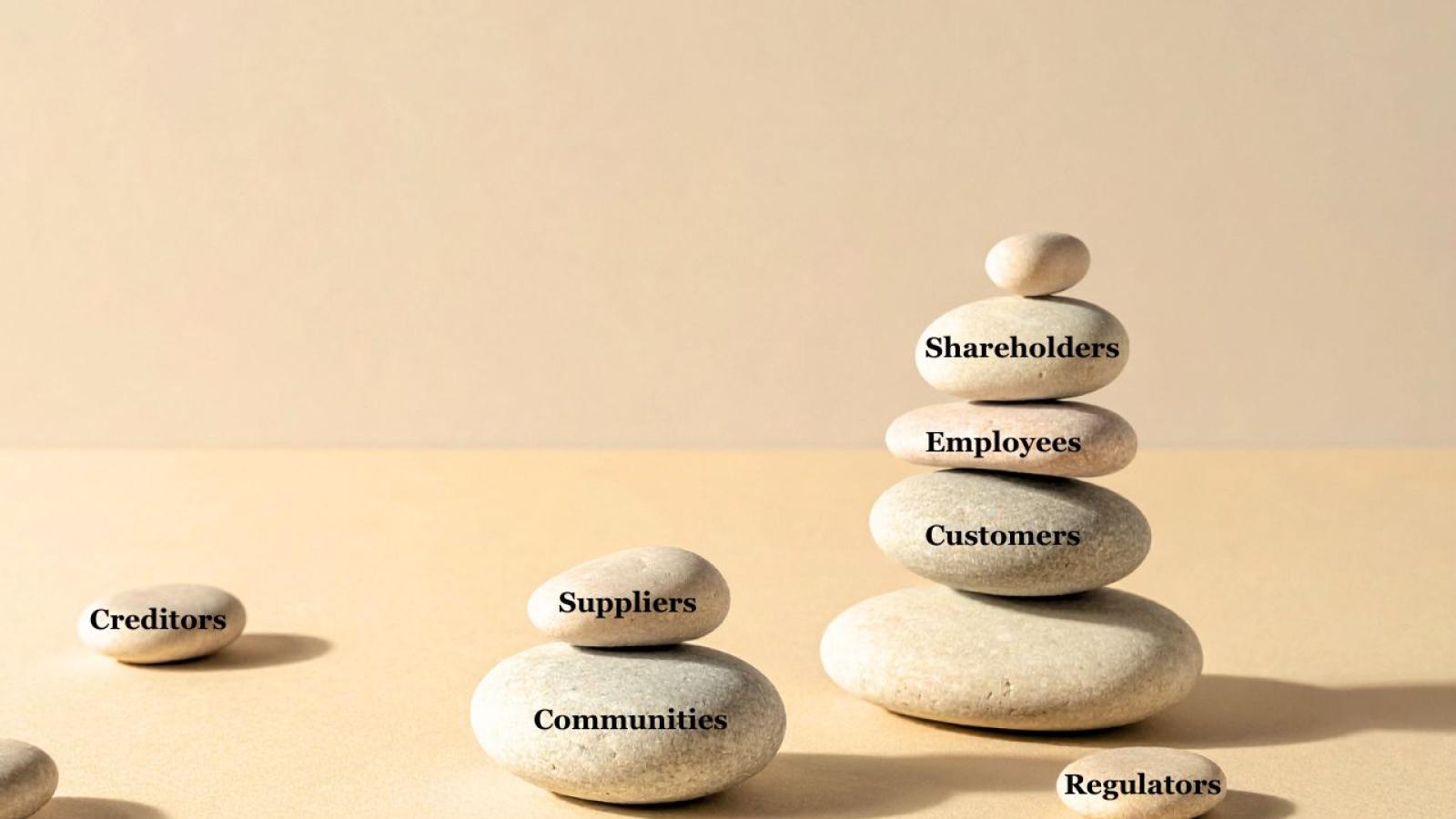
That includes employees, customers, suppliers, regulators, government and the communities where we operate. It also means thinking seriously about our environmental impact and maintaining the highest standards of business conduct. In other words, the job of a director has evolved. And frankly, it needed to.
Too often in the past, boardrooms were narrowly focused on financial performance. But that mindset is no longer fit for purpose. Today, if you’re not thinking about culture, sustainability, or good customer outcomes, you’re not just behind the curve—you’re exposing the business to real risk.
That’s why, when I consider joining a board, I look beyond the numbers. Of course, understanding the business model matters. But I also want to know: what kind of organisation is this, really? How does it behave when things go wrong? What’s the culture like behind closed doors? And perhaps most importantly, can I trust the people I’ll be sitting alongside?
Trust in the boardroom isn’t a “nice to have”—it’s fundamental. Without it, decision-making becomes defensive, fragmented, and ultimately ineffective. I’ve found that the most effective boards are those with a clear sense of purpose and a strong set of values. Not the kind framed on a wall, but the kind that actually shape decisions. You can usually tell the difference within a few meetings.
In smaller organisations, like the ones I’m involved with, these questions become even more nuanced. We don’t have the same resources as large corporations, so discussions around climate change or sustainability have to be proportionate. But that doesn’t mean they’re optional. In fact, I’d argue the opposite. Smaller businesses often have more agility to adapt and can turn responsible practices into a genuine competitive advantage. Customers increasingly care about how businesses operate. So do employees. If you want to attract good people—and keep them—you need to stand for something.
There’s also a commercial reality here. Ignore these issues, and you risk falling behind competitors who are already adapting. So, it’s the right thing to do—but it’s also just good business practice.
One practical question that often comes up is: where do these discussions actually sit?
My board committees do a lot of the heavy lifting. Risk and audit committees, in particular, tend to dive deep into governance, operational resilience, cyber security, and conduct. But these aren’t niche topics. They surface at the main board too, especially where they impact the business’ strategy or stakeholders.
Take employees, for example. We don’t just look at headcount or costs. We examine engagement data, retention trends, and cultural indicators. Are people leaving at higher rates than they should be and compared to our peers? Are we attracting the right talent? Are we rewarding them fairly?
And we go deeper. What’s our gender pay gap? What actions are we taking to address it? Are inclusion efforts actually working, or just well-intentioned? These are not peripheral concerns—they go directly to the health and sustainability of the business.
Suppliers are another critical stakeholder. It’s no longer enough to assess them on cost and delivery. We need to understand how they operate. Do they meet appropriate standards on labour practices, whistleblowing, and governance? There’s also a real awareness of how vulnerable supply chains can be. Cyber risks, in particular, have made this clear. A weakness in a third party – as Jaguar Land Rover painfully discovered last year - can quickly become your problem—with serious operational, financial and reputational consequences.
To obtain meaningful independent assessments, boards deploy internal and external auditors who can provide an objective view on everything from cyber security to culture to ESG performance. These audits are invaluable. They tell you not just how you think you’re doing, but how you compare to others—and where the gaps are, along with the actions required to remediate them.
Then there are industry regulators. For my financial services boards, the relationship with our regulators is critical. It needs to be constructive, transparent, and responsive. If concerns are raised, boards must act quickly—not just to fix the issue, but to address the root cause.
In financial services, there’s been an increasing focus on positive customer outcomes. Quite rightly, the customer now has a real voice in the boardroom. It’s no longer acceptable to assume that if the numbers look good, everything else is fine. Boards need real data and management information to evidence their behaviour. Are our products being sold responsibly and appropriately? Are our customer communications clear? Are vulnerable customers identified and supported? These are not abstract questions—they’re central to how the business is judged.
All of this reflects a broader shift in expectations. Businesses are no longer seen as purely economic entities. They’re expected to act responsibly—and to prove it.
But let’s not pretend this is easy.
I once joined the board of a consumer lending business that was in trouble with the regulator and in financial difficulty. It had a strong sense of purpose and the new board members wanted to try and turn it around to help a vulnerable section of the market. This required intense effort—strengthening risk processes, rebuilding trust with regulators, and managing relationships with investors and creditors.
Over time, the situation became increasingly critical, and we realised we’d have to consider a solvent wind-down. That’s when the pressure hit. The key question we had to ask ourselves in each board meeting was whose interests we should prioritise. Shareholders? Or creditors, like bondholders, who would rank ahead in any distribution of assets?
These weren’t theoretical discussions. The stakes were personal. If creditors believed their interests were being compromised, they would be able to pursue directors individually. Every decision had to be meticulously considered, documented, and backed by legal advice. The board minutes needed to be scrutinised and approved by independent lawyers and accountants.
It was a stark reminder that being a director carries real responsibility—and real risk. And that’s the reality of modern board life. It’s complex, demanding, and at times overwhelming. The volume of information alone can be staggering. Board packs grow thicker, agendas get longer, and expectations keep rising.
But at its core, the role hasn’t changed. It’s still about judgement. About balancing competing interests. About making decisions that will stand the test of time and deliver good outcomes for all of our stakeholders.
And above all, it’s about integrity. Because when the pressure is on—and it will be—you fall back on your principles. If those principles no longer align with the organisation or the people around you, then the hardest decision may also be the right one: to walk away. That, too, is part of the job.
_________________
Maria Darby-Walker is a Senior Independent Director at Personal Group plc, and a Senior Independent Director, Chair of the Remuneration Committee and Employee Director at Redwood Bank.
This blog is based on a discussion held at the Intesa Sanpaolo Business Law and Regulation Conference: "Directors' responsibilities in a time of change" on 6th March 2026. Visit the event page to explore more conference-related blogs.
The ECGI does not, consistent with its constitutional purpose, have a view or opinion. If you wish to respond to this article, you can submit a blog article or 'letter to the editor' by clicking here.