The ECGI blog is kindly supported by

Business Ethics Is Inherently Political
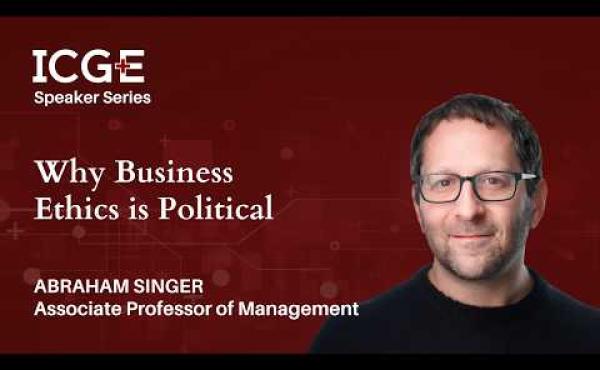
A review of the Kelley-ECGI Lecture “Why Business Ethics is Political” by Professor Abraham Singer on 5th March 2026.
When a mayor awards a lucrative city contract to his own son and defends the decision by saying "it is a father's duty to help his son," he is not wrong about parental obligation. What he has forgotten, or chosen to ignore, is that the office he holds comes with a different set of rules. The power entrusted to him belongs to a public institution, and that changes everything. This apparently simple episode, drawn from the reign of Chicago's Richard J. Daley, sits at the heart of a far-reaching argument advanced by Professor Abraham Singer and his co-author Amit Ron: that business leaders, like mayors, are holders of social offices, and those offices come with democratic obligations that neither individual conscience nor fiduciary loyalty can fully satisfy.
The argument is developed in their book Everyone's Business (University of Chicago Press), and it begins with a tension at the foundation of commerce. Firms are “partial” institutions, oriented toward profit and organisational goals, but their decisions inevitably affect workers, consumers, communities, and political processes. This creates a structural tension between partiality and impartiality—between the pursuit of corporate interests and the broader obligations owed to society.
Traditional approaches to business ethics struggle to resolve this tension, either emphasizing the impartial demands of morality without taking seriously the partiality of business, or emphasizing the partiality of fiduciary obligations, and minimizing the broader social constraints on those pursuits. The alternative is a "political" approach, which treats roles such as CEO or director as social offices carrying responsibilities grounded in their function within society. Firms are granted licence to pursue profit because, under appropriate conditions, this contributes to economic efficiency and social welfare. That justification, however, is also a constraint. When businesses pursue profit through pollution, fraud, or the systematic gaming of democratic processes, they undermine the very rationale that licenses their partiality. A boxer may punch his opponent, but he may not wrestle or bite him. Nor may he punch the referee or bribe the ringside doctor.
Yet defining the "social good" is contentious. Modern societies are characterised by reasonable pluralism: individuals hold divergent values and conceptions of the good life. As a consequence, law and public morality ought to remain as neutral as possible with respect to how people pursue their life's projects. No single ethical vision can legitimately dominate. Instead, societies rely on democratic processes to negotiate disagreement, making business ethics, in this sense, inseparable from democratic ethics.
Democracy is primarily a system of second-order rules: fair processes — elections, deliberation, accountability, and the right to lawful protest — through which societies resolve first-order disagreements about what is right or wrong, permissible or impermissible. Businesses are uniquely positioned to distort these processes. Through monetary influence, they affect elections and lobbying. Through marketing, PR, and the cultural reach of figures like Elon Musk, they shape public discourse. And as governance institutions, large corporations hold organisational power over employees that affects their capacity for civic participation. Critically, this concern applies even when firms act with benevolent motives: substituting private judgment for democratic procedure erodes political equality regardless of intent.
From this diagnosis, three principles emerge. The duty to democratic outcomes holds that businesses should comply not only with the letter of democratic law but with its spirit, treating laws as collective decisions to be respected, not financial obstacles to be cleared. Uber's deliberate expansion into cities where ride-sharing was prohibited is the paradigm case; that the company simultaneously invoked historical examples of civil disobedience to justify its conduct only sharpens the point, deploying the language of democratic conscience to dress up straightforward law-breaking. The duty to publicity requires that decisions with significant public consequences be open to scrutiny; Meta's strategy of timing the reintroduction of facial-recognition technology in its AI glasses to coincide with periods of public distraction illustrates precisely what this duty prohibits. And the duty to reflection demands that firms actively consider the democratic consequences of their conduct, a weightier obligation than it sounds: it may require creating dedicated roles and organisational structures within firms to ensure such reflection actually happens, rather than being crowded out by financial or operational pressures.
These principles also bear on a question that has become increasingly live in corporate life: the use of political positions as marketing. When companies attach themselves to social movements or political causes as a branding exercise — for instance, Pepsi’s infamous “Live For Now” commercial — the damage goes beyond cynicism. It orients consumers to approach politics in a transactional, instrumental way, eroding the deliberative quality on which democratic life depends. Corporations cannot remove themselves from politics — even decisions about where to locate a business carry political consequences — so the real demand is not abstention but accountability.
This raises difficult questions. How should firms respond when laws appear unjust? To what extent should they engage in political advocacy? How can internal governance structures be designed to make these duties operational rather than aspirational? There are no universal answers; the solutions will differ firm by firm. But identifiable tools exist: splitting decision-making authority, mandatory deliberation periods, and the inclusion of external voices – forms of institutional friction that slow down choices with large public consequences before they are made.
Ultimately, the claim that "business ethics is political" is not a call for firms to become partisan actors. It is a recognition that corporate activity is already embedded in political systems, and that with this embeddedness comes responsibility. The challenge is not whether businesses should engage with democracy, but how they can do so in ways that sustain, rather than distort, the processes through which societies govern themselves.
-----------------------------------
This lecture is part of the Indiana University - ECGI Online Series, a public lecture series on corporate governance. The Kelley School of Business Institute for Corporate Governance (ICG+E), in partnership with Ethical Systems, collaborates with ECGI to deliver this ongoing initiative. As part of this public lecture series, distinguished speakers share insights on the evolving landscape of governance, finance, and market regulation.