Corporate Governing and Shareholder Voice with Jill Fisch and Tim Smith
Episode Summary
For decades, the shareholder proposal has been the primary channel through which investors can signal their priorities to corporate management. It doesn't force anyone to do anything — but it creates a public record, produces a vote, and in practice carries real weight. Now that mechanism, along with much of the broader shareholder engagement ecosystem, is under coordinated attack.
In this episode, host Matteo Gatti (Professor of Law at Rutgers Law School and author of Corporate Power and the Politics of Change) explores three questions: Why has corporate political engagement become so fraught? What do we actually know about how the shareholder proposal process works as a tool of political accountability? And what happens next, now that the entire infrastructure is under pressure?
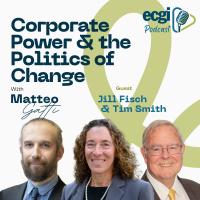
Jill Fisch (University of Pennsylvania Carey Law School) brings the doctrinal and empirical lens, drawing on three co-authored papers — a 2024 diagnosis of what she and Jeff Schwartz call "political posturing," a 2026 framework for reconciling corporate values with long-term economic value, and a 2025 empirical study of the political disclosure proposal ecosystem with Adriana Robertson. Tim Smith (Interfaith Center on Corporate Responsibility) brings more than fifty years of practitioner experience pressing corporations on political and social behaviour — and, as this episode makes clear, is now helping to litigate the legal future of the proposal system itself.
Jill Fisch is the Saul A. Fox Distinguished Professor of Business Law at the University of Pennsylvania Carey Law School and a Research Fellow of ECGI. She is one of the most influential corporate law scholars of her generation.
Tim Smith is Senior Policy Advisor at the Interfaith Center on Corporate Responsibility (ICCR), where he supports work on responsible political engagement and the response to anti-ESG pressure. Previously he was Director of ESG Shareholder Engagement at Boston Trust Walden. He serves on the board of WestPath, the United Methodist Pension Board. He has been engaged in shareholder activism on corporate responsibility issues for over fifty years.
Matteo Gatti is Professor of Law at Rutgers Law School, where he writes on corporate power, governance, and political economy. He is a Research Member of ECGI and the host of this podcast.
Key Topics Covered
What Is "Political Posturing" and Why Does It Matter? Drawing on her work with Jeff Schwartz, Fisch distinguishes between two things that often get conflated. The first is ordinary corporate decision-making that happens to have social implications — how workers are treated, what packaging a company uses, how it responds to climate risk. That is simply doing business. The second is what they call political posturing: corporations issuing statements and taking public stands on contested issues that are largely disconnected from their actual operations, often without a coherent strategy and in response to stakeholder pressure. The danger of posturing is a feedback loop: once a company speaks out on one issue, stakeholders expect it to speak out on the next, and there is no natural stopping point.
Smith introduces an important counterpoint: many issues that now appear "political" are in fact fundamental business responsibility questions — labour standards, climate risk, diversity — that companies have been managing for decades. The politicisation of those issues is recent and largely externally imposed, not a product of corporate overreach.
The Difficult Case of Disney The Disney/DeSantis confrontation illustrates the bind companies increasingly face. Disney did not seek to enter the fight over Florida's "Don't Say Gay" legislation. It was drawn in when the Orlando Sentinel reported that Disney had been financing the bill's proponents, triggering a backlash from employees and other stakeholders. The episode shows both how hard it is to stay neutral when a position is forced on you, and how costly engagement can be once it escalates into a direct confrontation with government.
Corporate Values and Long-Term Economic Value Describing her 2026 paper with Schwartz, Fisch argues that the apparent tension between corporate values and shareholder value is largely false. For most companies, ESG considerations are not separable from economic value — workplace safety, climate exposure, data governance, and supply chain ethics all have material financial implications. The paper's prescription is that managers should select corporate values genuinely aligned with the long-term interests of their specific corporation and its shareholders, rather than either performing empty gestures or treating values as entirely independent of economic performance. However, relative to consumers and employees, shareholders face unique structural impediments in communicating their values to corporations — and Fisch argues that the shareholder proposal rule is the central mechanism for bridging that gap.
Both guests are critical of the current Department of Labor position, which appears to treat ESG considerations as inherently non-financial and therefore inconsistent with institutional investors’ fiduciary duties. Smith notes that the Principles for Responsible Investment — whose signatories collectively manage over $126 trillion in assets — represent a mainstream global consensus that ESG analysis is simply good investing.
How Shareholder Proposals Actually Work Fisch and Adriana Robertson's 2025 empirical paper focuses on political disclosure proposals — resolutions asking companies to disclose their political spending, lobbying activities, and trade association memberships. Key findings include:
- Political disclosure proposals are the highest-volume category in the ESG space and command average support of 25–30%, with some reaching majority support.
- A substantial number of proposals are submitted, negotiated, and withdrawn before any vote — the proposals that go to a vote are the tip of the iceberg.
- The absence of any centralised filing requirement means the true volume of shareholder engagement through this channel is systematically understated.
- The evidence suggests proposals make a difference: companies that are targeted tend to increase their transparency following a proposal.
- Shareholder proposals and private engagement are complements, not substitutes and the credibility of private engagement depends on the proposal process being available as a backstop.
Voting Choice Programmes and the Limits of Retail Participation Fisch raises concerns about "voting choice" or "proxy choice" programmes being rolled out by large institutional investors, which give retail investors in mutual funds a limited menu of pre-set voting policies. The menu is curated and narrow, meaning investors are not genuinely getting choice. More fundamentally, fragmenting institutional votes undermines the expertise and heft that make institutional engagement effective. Ironically, the voting policies on offer are typically developed by proxy advisory firms — the same firms that an executive order from the Trump administration has targeted as too dangerous to advise institutional investors.
The System Under Attack The episode closes with a detailed account of the coordinated pressure on the shareholder engagement infrastructure. The SEC has withdrawn from the no-action process that historically provided guidance on whether companies could exclude shareholder proposals. SEC Chair Atkins has suggested precatory proposals may be impermissible altogether. An executive order has targeted proxy advisory firms ISS and Glass Lewis. Texas has enacted legislation constraining the proposal process for certain investors.
ICCR and allied investors have responded with litigation, no-vote campaigns against board members, and independent solicitations. Six lawsuits were filed in the current proxy season alone. Several companies that attempted to exclude resolutions have been forced by court injunction to restore them. Others have settled and committed to expanded disclosure rather than face contested director elections.
Fisch's assessment is that whatever the legal outcome, institutional investors have spent twenty years developing the expertise and habit of holding boards accountable, and that won't be easily reversed. If the proposal rule is weakened or repealed, the likely result is not less shareholder activism but more confrontational forms of it — binding bylaw amendments, election contests, and withheld votes on executive compensation.
The episode also touches on state-level efforts in Montana and Hawaii to limit corporate political spending by capitalising on the fact that corporations are creatures of state law. Since states create corporate entities and define their powers, there is a credible constitutional argument that states can limit those entities' political spending — an approach that works around Citizens United rather than challenging it directly.
Links
- Corporate Power and the Politics of Change by Matteo Gatti (Cambridge University Press)
- How Did Corporations Get Stuck in Politics and Can They Escape? by Jill E. Fisch & Jeff Schwartz (2024)
- Corporate Value(s) by Jill Fisch & Jeffrey Schwartz (2026)
- Proxies for Politics by Jill Fisch & Adriana Robertson (2025)
- The Proxy Voting Choice Revolution by Alon Brav, Tao Li, Dorothy S. Lund & Zikui Pan (2025)
- Interfaith Center on Corporate Responsibility (ICCR)
- New ICCR Resource Spotlights Corporate Governance Failures By Companies Amid SEC Oversight Vacuum
- ICCR Issues New Report on Proxy Voting Records and Executive Compensation at Large Asset Managers
- Center for Political Accountability / Zicklin Index
- Principles for Responsible Investment
Other Episodes:
- The Economics of Corporate Governing with Swarnodeep Homroy and Elizabeth Kempf - Ep. 2 in Corporate Power and the Politics of Change with Matteo Gatti
- The Law of Corporate Governing with Stephen Bainbridge and Roy Shapira - Ep. 1 in Corporate Power and the Politics of Change with Matteo Gatti
Corporate Power and the Politics of Change is an ECGI podcast. All episodes are available on the ECGI website and wherever you listen to podcasts, including YouTube.
Connect with us:
Speakers


Jill Fisch