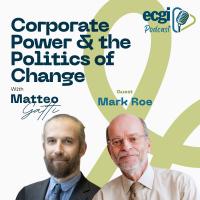
The Limits of Private Sector-led Reform with Mark Roe
Episode Summary
For a moment in the 2010s, the stars seemed aligned. BlackRock, managing over $14 trillion in assets, was telling every major CEO on the planet that climate was an existential risk and corporations had to act. The Business Roundtable declared that shareholder primacy was over. Hundreds of companies updated their purpose statements, hired sustainability officers, and made public commitments. Then, in a matter of years, almost all of it reversed. Mark Roe's argument is that this was not bad luck or bad timing. The failure was written into the premise from the start.
Host Matteo Gatti's book Corporate Power and the Politics of Change documents how corporations stepped into spaces governments had vacated. Roe's new paper explains why that private route was always going to be blocked: the same political forces that prevented Congress from acting on climate were lying in wait for the private route as well. The conversation traces this argument from Roe's foundational 1998 backlash thesis through his 2021 work on corporate purpose and competition, and into his new account of why shareholder-driven CSR failed — arriving, finally, at the hardest question: if the state won't act and the private route is blocked, where does that leave reformers?
Mark Roe is the David Berg Professor of Law at Harvard Law School and a Fellow of ECGI. Among the most influential corporate law scholars of his generation, his books — Strong Managers, Weak Owners (Princeton University Press, 1994) and Political Determinants of Corporate Governance (Oxford University Press, 2003) — established that politics, not legal rules alone, determines the shape of corporate governance across economies. His most recent book, Missing the Target: Why Stock Market Short-Termism Is Not the Problem (Oxford University Press, 2022), debunks one of the most durable narratives in corporate governance. His new article, "Why Shareholder-Driven Corporate Social Responsibility Failed," is forthcoming in the University of Pennsylvania Law Review.
Matteo Gatti is Professor of Law at Rutgers Law School, where he writes on corporate power, governance, and political economy. He is a Research Member of ECGI and the host of this podcast.
Key Topics Covered
The 1998 Backlash Thesis and Its Application Three Decades Later Roe's 1998 Columbia Law Review article established what has since become axiomatic in corporate governance scholarship: politically organised interests can mobilise to override market-led equilibria, making even efficient corporate arrangements structurally fragile. The insight was not merely descriptive. It identified a hard constraint on what corporate law can achieve: the political foundation of any given arrangement sets the outer limit of what reformers can accomplish. Roe's new CSR paper is, in his own framing, a direct application of that thesis. The institutional investors who pushed corporate America on climate did not outmanoeuvre the political forces that had blocked legislative action — they activated them.
Two Kinds of Broken Government The foundational premise of shareholder-driven CSR is that government is broken and cannot act. But Roe distinguishes between two very different types of governmental dysfunction, which have very different implications for whether private substitutes can work. If government is broken simply because it lacks the institutional capacity to act — gridlock, procedural obstacles — then private CSR can fill the gap and potentially stick. But if government is broken because organised interests actively blocked it from acting, those same interests constitute a latent political force that can, and will, mobilise against the private route once it gains traction. It is the second type of brokenness that characterised the climate fight in the United States — which meant that the premise of shareholder-driven CSR was structurally unsound from the beginning.
The BlackRock Trajectory: A Case Study in Political Miscalculation Roe traces the arc from Larry Fink's annual letters to CEOs in the 2010s — insisting that climate was an existential risk requiring corporate action — through the anti-ESG legislative push led by Texas and over twenty other states, to BlackRock's withdrawal in 2023 with the statement that it was "not the environmental police." Roe argues that BlackRock's leadership genuinely did not anticipate the severity of the political response. He also suggests a secondary miscalculation: BlackRock likely believed it could market ESG positioning to European institutional investors while maintaining its American client base. That proved impossible — the political cultures diverged too sharply, and crucially, the US has a powerful domestic hydrocarbon industry with legislative representation, while the EU largely does not.
Private Ordering and Its Structural Limits The conversation extends to a broader question about private ordering as a reform mechanism. Roe identifies the most important structural constraint: private ordering works well when it involves parties bargaining over internal arrangements with no major externalities. It works poorly when the thing being ordered is itself an externality — a cost imposed on third parties who are not at the bargaining table. Climate is precisely such a case. Even setting aside political opposition, getting competitive markets to internalise carbon costs through voluntary shareholder pressure faces a fundamental collective action problem that private ordering cannot resolve.
The Coalition That Wasn't: Executives, CSR Activists, and Co-optation Roe argues that CSR activists made a strategic error in aligning with large institutional shareholders rather than building a coalition with corporate executives. The executive route had potential because managers have more operational control over corporate behaviour than shareholders do. But Gatti and Roe converge on a shared diagnosis: executives largely co-opted CSR rhetoric for their own ends, using stakeholder language to expand managerial discretion and weaken shareholder oversight, without delivering meaningful new corporate social commitments. The CSR activists, Roe argues, should have pushed for binding mechanisms — board seats, contractual obligations — rather than accepting voluntary promises. The missed opportunity was also, as Roe acknowledges with some candour, not entirely to be regretted from a corporate governance standpoint: more executive discretion, in general, is not a good outcome.
The Controlling Shareholder Problem The rise of companies with dominant controlling shareholders — Zuckerberg at Meta, Brin at Google, and comparable figures — creates a structural instability that compounds the problem. Where diffuse ownership gives institutional investors at least some potential leverage, a controlling shareholder can reverse course unilaterally and at will. The ESG commitments of the 2010s, Roe notes, are harder to maintain in a world increasingly dominated by firms where one person holds effective veto power over strategic direction.
Short-Termism, Externalities, and the Power of Narrative The conversation draws a direct connection to Roe's earlier work debunking short-termism as the root cause of corporate social failures. In a paper with Roy Shapira, Roe analysed why the short-termism narrative became so politically powerful despite the empirical evidence being mixed at best. Their answer: short-termism has three narrative advantages — immediate negative connotation, category confusion (many corporate failures that are actually about externalities get relabelled as short-termism), and repeated reinforcement by powerful agenda-setters. The policy implication matters: if pollution is misdiagnosed as short-termism, the remedies proposed will be wrong. The correct diagnosis — externalities — is less rhetorically powerful but more analytically precise.
Links
- Why Shareholder-Driven Corporate Social Responsibility Failed by Mark Roe, University of Pennsylvania Law Review (forthcoming 2026)
- Corporate Purpose and Corporate Competition by Mark Roe, 99 Washington University Law Review 223 (2021)
- Backlash by Mark Roe, 98 Columbia Law Review 217 (1998)
- The Power of the Narrative in Corporate Lawmaking by Mark Roe and Roy Shapira, 11 Harvard Business Law Review 233 (2021)
- Missing the Target: Why Stock Market Short-Termism Is Not the Problem by Mark Roe, Oxford University Press, (2022)
- Strong Managers, Weak Owners: The Political Roots of American Corporate Finance by Mark Roe, Princeton University Press (1994)
- Political Determinants of Corporate Governance by Mark Roe, Oxford University Press, (2003)
-
Corporate Power and the Politics of Change by Matteo Gatti, Cambridge University Press, (2025)
Other Episodes
- Reforming the Law of Capitalism with Katharina Pistor - ep. 7 in Corporate Power and the Politics of Change with Matteo Gatti
Corporate Power and the Politics of Change is an ECGI podcast. All episodes are available on the ECGI website and wherever you listen to podcasts, including YouTube.
Connect with us: