Working Papers Scope Guide
This page provides guidance on whether a paper is suitable for the ECGI series.
Scope checker tool
This tool allows you to paste your abstract into a form to receive an indicative assessment of whether your paper is likely to be within the scope of the Finance or Law series. This tool does not replace editorial review — it is intended to help authors self-screen before submitting. The indication is based on the range of papers currently in the ECGI series.
The ECGI Working Paper Series publishes research on corporate governance across two streams: the Finance Series and the Law Series. This page describes what each series covers and is intended to help authors assess whether their work is likely to be in scope before submitting.
Scope of the ECGI Working Paper Series
The central question
Both series apply the same primary contribution test: corporate governance must be the paper's central subject, not merely its setting or empirical context.
A paper that uses a governance variable as a control, or that studies firms as economic actors without examining how they are governed, directed, or held accountable, is unlikely to meet this threshold — regardless of how governance-adjacent the topic may appear.
The Finance Series
The Finance Series publishes financial economics research in which corporate governance is the primary subject. In-scope topics include:
Typically in scope
- Board structure and decision-making
- Executive compensation and incentives
- Ownership structure and shareholder activism
- Institutional stewardship and investor engagement
- Mergers, acquisitions, and the market for corporate control
- Creditor rights and governance in financial distress
- Disclosure and transparency as governance mechanisms
- Governance of family firms, SOEs, and PE-backed companies
ESG and sustainability
In scope
A study of how boards set and oversee executive pay linked to emissions targets. The paper's central contribution is about board oversight and incentive design — ESG is the context, governance is the subject.
Outside scope
A study of whether firms in regional industrial clusters reduce their greenhouse gas emissions. The paper's central contribution is about environmental outcomes; corporate governance mechanisms are not examined.
In scope
A study of how institutional investors engage portfolio companies on climate risk disclosure. Investor behaviour and stewardship are the subject; climate is the domain in which governance is exercised.
Outside scope
A model of how uncoordinated national climate policies reshape global supply chains. The contribution is to climate economics and supply chain theory; corporate governance does not feature in the central argument.
Capital structure and corporate finance
In scope
A study of how debt covenant design affects the balance of power between creditors and shareholders in distressed firms. The governance of the creditor–shareholder relationship is the central subject.
Outside scope
A model of optimal leverage responses to interest rate changes in private equity fund structures. The contribution is to capital structure theory; governance of the fund or portfolio companies is not addressed.
The Law Series
The Law Series publishes legal scholarship — doctrinal, comparative, empirical, and theoretical — on corporate and related financial law. In-scope topics include:
Typically in scope
- Fiduciary duties and director liability
- Shareholder rights and derivative litigation
- Securities regulation bearing on governance
- Comparative and international corporate law
- Insolvency law and stakeholder relations
- Legal dimensions of institutional stewardship
- AI, digital assets, and platform governance
- Sustainability disclosure and directors' duties
Boundary cases
In scope
A study of how directors' duties are being interpreted in jurisdictions that have adopted sustainability reporting obligations. Corporate law and board accountability are the subject; sustainability regulation is the context.
Outside scope
Legal analysis of a regulatory sandbox framework for the legal profession, illustrated with examples from financial regulation. The paper's subject is the regulation of the legal profession; corporate governance is not examined.
In scope
A comparative study of how different insolvency regimes allocate control between creditors and shareholders when a firm enters distress. The governance of the creditor–shareholder relationship in distress is the subject.
Outside scope
A study of mediation practices in Chapter 11 proceedings, focused on dispute resolution procedure. The contribution is to procedural dispute resolution; the governance of the firm in distress is not the focus.
In scope
Legal analysis of how smart contract technology changes enforcement of shareholder agreements. The governance implications for corporations and their shareholders are central.
Outside scope
An analysis of how smart contracts can substitute for property law, with a corporate acquisition used as one of several illustrative examples. The paper's contribution is to property theory; corporations are not the subject.
Eligibility
Submission is open to ECGI research members. Papers that have already been published in a journal or book are not eligible. Working paper versions of manuscripts under review are acceptable.
If you are uncertain whether your paper falls within scope, you are welcome to send a brief query — title and abstract — to the editorial team at wp@ecgi.org before submitting.
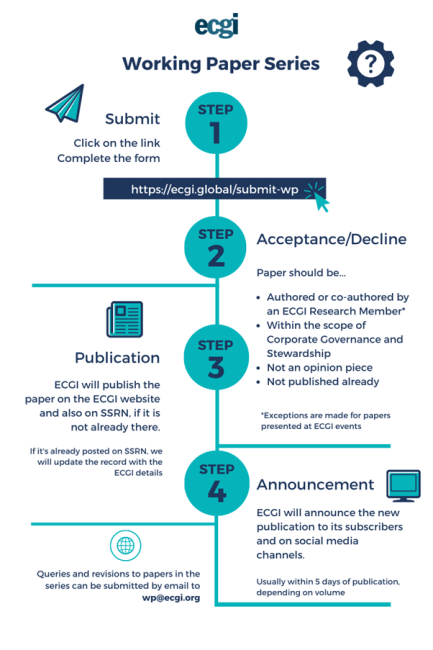
Working Paper
Who can submit a research paper to the series?
The primary purpose of the two series is to publish research papers on corporate governance related topics that are authored or co-authored by ECGI Research Members(Link) and ECGI Fellows.
Can a paper be submitted by non-ECGI Research Members?
No, but exceptions can be made on two counts:
- For a paper that has been delivered at academic conferences or workshops organised or endorsed by the ECGI;
- For a paper that is included in an ECGI Research Newsletter.
How is a paper submitted?
A research paper is voluntarily submitted by its author or co-author to one of two Editorial Boards, Law or Finance. To do so, the authors or co-authors may submit it Using this form, stipulating for which series it intended.
How is a paper reviewed and accepted for inclusion in the series?
The Editorial Boards(Link) which comprise an Editor and a number of Consulting Editors drawn from ECGI's Research Membership then scrutinise the paper to determine whether or not it is suitable for inclusion in the Law or Finance series. The Editors do not referee the paper but merely screen it for general suitability.
Why might a paper be refused inclusion in the series?
A paper would be rejected if it is considered by the Editorial Boards to be an opinion piece i.e. not a true research paper or if the topic is not related to corporate governance, even in the broadest sense.
Will the WP series publish papers on corporate governance that comment on aspects of corporate governance without reporting on primary research?
The acid test for inclusion is whether the paper could be published in a scholarly journal. As such, the main focus is on research papers. Essays, longer surveys or handbook chapters will typically also be included. Comments, op-ed pieces, cases, or teaching notes will not be included.
Will the WP series also publish papers in other areas closely related to corporate governance, such as corporate finance, banking, financial regulation, or the financial crisis?
The WP series editors will generally apply a broad definition of corporate governance and also include papers on the interface between corporate governance and other areas, or papers of which only a part touches on corporate governance. However, papers in other areas whose relevance for corporate governance is only indirect or methodological will not be included. Examples of papers that will be accepted include works:
- > covering topics of financial regulation that have an impact on how firms are, or should be, governed/managed/owned;
- > dealing with the financial crisis, when implications can be drawn on how financial institutions are, or should be, governed/managed/owned.
Examples of papers in other areas whose relevance for corporate governance is only indirect or methodological include:
- > contributions to banking and financial institutions that do not address governance issues;
- > macroeconomic discussions of the financial crisis, sovereign debt markets or related phenomena that do not explicitly address the governance of firms or financial intermediaries.
What happens when a paper has been accepted for inclusion in the Working Paper Series?
Once approval to publish has been given on behalf of the Editorial Board by the Editor, the Editorial Assistant then takes a number of steps including:
- the addition of a cover page in the ECGI format.
- the paper is added to the SSRN collection as well as the ECGI website.
- an alert is sent to all the ECGI Members.
- the paper can be featured on the ECGI website.
All papers accepted to the series wil be entered into consideration for the Annual Working Paper Prize which is awarded eavh year et the ECGI Annual Members' Meeting.
Where is the Working Paper published?
A new addition to the ECGI series is announced in the Working paper section of the ECGI website and by the dispatch of a New Working Paper alert to all ECGI members. The paper's abstract and the paper itself can be downloaded free of charge from SSRN's Financial and Legal Research Institutes Papers Series.
How is the paper published on the SSRN?
When a paper is submitted to the ECGI, one of three things will then happen:
a - If the paper is not on the SSRN server already, the ECGI formatted paper will be added to the SSRN collection as a separate entry. See example(LINK)
b - If a "mimeo" version exists on the SSRN server it will be replaced by the ECGI paper. See example(LINK)(the ECGI paper replaced the older EFA conference version).
c - If a US Law School or another "generic" version exists on the SSRN server, a reference to the ECGI paper is added to the front page of this paper and a hyperlink to the ECGI formatted paper that will, in this case, reside on the ECGI server.
If the author submits the paper to a series that has the same status as the ECGI series on SSRN (e.g. a US Law School series), the ECGI paper on the SSRN server will be replaced by a "generic" paper and the ECGI version of the paper will be moved to the ECGI server. The hyperlink to the ECGI paper on the ECGI server is displayed on the front page of the "generic" paper on SSRN.
Multiple submissions to the ECGI, the CEPR and NBER electronic series do not fall under (b) or (c) because the CEPR and NBER series are fee based.
How can I find out how many times a paper has been downloaded from SSRN?
Statistics (Abstract Views, Downloads and Download Rank) are shown on a paper's SSRN Abstract/Download page. They can also be tracked from the ECGI specific reports on the SSRN eLibrary Search Results pages as follows:
Can I submit my paper directly via SSRN instead of sending it to ECGI?
No, ECGI is not alerted when you post a paper on SSRN, even when you select the ECGI RPS distribution.You must use the ECGI channels to submit a paper to the series (i.e. the submission form). You can do this before or after posting on SSRN.
Does publication in the series prevent me from publishing in a journal?
On the contrary, publication in the working paper series should support your endeavours to have the paper published in a journal. ECGI has no exclusivity policy.
Will you update my paper on SSRN or should I do this?
If your paper is accepted to the ECGI Series, we will publish it on SSRN and send you the link. If you have already uploaded it to SSRN, we will update the SSRN record with the ECGI details.
How do I submit a revised version of my ECGI working paper?
You can make revisions as usual to the paper on SSRN and ECGI will be notified (this only applies to papers in the ECGI series). We will then update the new paper on the ECGI website and re-add the ECGI cover page on SSRN.