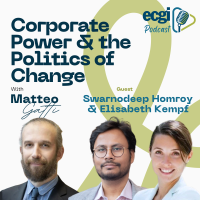
The Economics of Corporate Governing with Swarnodeep Homroy and Elisabeth Kempf
Episode Summary
Most S&P 500 CEOs are Republican donors. Yet for the better part of a decade, the statements coming out of corporate America have leaned overwhelmingly Democratic. Is that hypocrisy, ideology, or something more calculated?
In this episode, host Matteo Gatti (Professor of Law at Rutgers Law School and author of Corporate Power and the Politics of Change) brings together two economists who have been studying exactly this question from different angles. Swarnodeep Homroy (University of Groningen / University of Southampton) finds that CEO activism is largely strategic — a rational response to an asymmetric, polarised consumer landscape. Elisabeth Kempf (Harvard Business School) finds that partisan corporate speech has, on average, generated negative stock returns, and traces the phenomenon to a changing investor base rather than a shift in management ideology. Together, they reveal a considerably more complex picture than either the "woke capitalism" critique or its defenders tend to acknowledge.
Swarnodeep Homroy is Associate Professor at the University of Groningen and the University of Southampton. His paper with Sebastian Gangopadhyay, "Strategic CEO Activism in Polarized Markets" (Journal of Financial and Quantitative Analysis), is a seminal empirical study of CEO activism. He has also co-authored work on corporate responses to January 6th and on partisan sorting in domestic supply chains.
Elisabeth Kempf is Associate Professor of Finance at Harvard Business School. Her research spans political economy, corporate governance, and finance.
Matteo Gatti is Professor of Law at Rutgers Law School, where he writes on corporate power, governance, and political economy. He is a Research Member of ECGI and the host of this podcast.
Key Topics Covered
The Strategic Logic Behind Democratic-Leaning Corporate Speech Homroy opens with the central paradox: why do Republican-donor CEOs consistently speak in a Democratic register? His answer is consumer geography. In a polarised country, Democrat-leaning consumers are concentrated in urban centres and react strongly and persistently to CEO statements on social issues — remaining sensitised for up to eight weeks after an incident. Republican-leaning consumers react, but only mildly, and return to baseline consumption within three to four weeks. For a value-maximising CEO, that asymmetry creates a clear strategic opportunity. Homroy's paper documents a small but meaningful average increase in firm value (around 0.12%) following CEO activism, with larger effects for companies operating in more politically polarised markets.
January 6th and the Limits of Strategic Commitment Homroy also discusses his research on corporate responses to the January 6th Capitol riot, when many firms announced pauses in political donations. The strategic logic is even more visible there: companies most exposed to political risk were the ones who quietly reversed their donation pledges within three months — a period when donations were unlikely to be made anyway given where the electoral cycle stood.
The Shifting Partisan Composition of Executive Teams Kempf introduces a different dimension: the people making these decisions are themselves changing. Drawing on voter registration data for top executives at S&P 1,500 firms from 2008 to 2022, she and her co-authors find two trends running in parallel. The executive pool as a whole has become slightly more Democratic since 2016 — though still roughly 70% Republican — but average executive teams have not become more diverse. Instead, political sorting has intensified: executives are increasingly joining teams that match their partisan affiliation and leaving those that don't. The result is that firms have become more politically homogeneous even as the broader talent pool has diversified. Early evidence suggests that losing politically misaligned executives is detrimental to stock price.
Partisan Corporate Speech: Tracking the Phenomenon Kempf's paper with William Cassidy measures partisan corporate speech directly, labeling company tweets as highly partisan when they closely resemble statements by Democratic or Republican politicians. The findings are striking: before 2017, strongly partisan corporate speech accounted for less than 0.5% of all company tweets. In some months after 2017, that figure was ten times higher. The increase was overwhelmingly Democratic in character and — crucially — was broad-based, appearing across sectors, geographies, CEO political affiliations, and firms with very different employee bases.
The Investor Mechanism — and Why Returns Were Negative The puzzle Kempf and Cassidy set out to solve is this: if firms are rationally responding to market signals, why did partisan speech produce negative abnormal stock returns of around 20 basis points on average? Their answer lies in the investor base. The rise in Democratic-sounding corporate speech tracks the growth of assets under management in sustainable funds remarkably closely, suggesting firms were responding to shifting investor preferences. But unlike the product market — where a firm can selectively target an aligned consumer segment — public equity markets require firms to raise capital from investors with very different political preferences. When a firm takes a partisan position, it may satisfy one group of investors but must discount the price to retain the other. The second key mechanism: once many firms have spoken out, silence itself becomes a political signal. Firms face a forced choice between two costly options, and the stock market captures that constraint.
The Welfare Question and What Has Changed Since 2022 Both guests are cautious about drawing strong policy conclusions. Kempf notes that her model does not resolve the welfare question: if investors derive genuine non-pecuniary utility from political alignment, the aggregate effect on welfare could be positive even if stock prices decline. Homroy observes that the window of strategic opportunity for Democratic-leaning corporate speech appears to be narrowing — consumer responses have become more symmetric, employees are more sceptical of performative stances, and political and regulatory costs have risen sharply under the second Trump administration.
New Directions: Polarisation in Supply Chains and Beyond The conversation closes with a broader view of how polarisation is reshaping corporate decision-making beyond speech. Homroy and co-author Nandini Gupta find that Democratic and Republican firms are increasingly choosing suppliers with the same partisan stripe. Kempf's work shows similar sorting effects in overseas sourcing decisions. Both guests call for more research into the feedback loop between corporate behaviour and societal polarisation — and into whether the current wave of polarisation is cyclical or structural.
Advice for Boards Asked for practical guidance, Kempf urges boards to be clear about why they want to enter a political debate — whether to drive demand, retain employees, or act on principle — and to develop better tools for hearing from all stakeholder groups, not just the loudest voices. Homroy echoes that deliberation is increasingly necessary as the political environment has become more symmetric and the costs of missteps higher.
Links
- Corporate Power and the Politics of Change by Matteo Gatti (Cambridge University Press)
- Strategic CEO Activism in Polarized Markets by Swarnodeep Homroy & Sebastian Gangopadhyay (2020)
- Partisan Corporate Speech by Elisabeth Kempf & William Cassidy (2025)
- The Political Polarization of Corporate America by Elisabeth Kempf, Vyacheslav Fos & Margarita Tsoutsoura (2022)
- Corporate Actions as Moral Issues by Elisabeth Kempf, Zwetelina Iliewa & Oliver Spalt (2025)
- Corporate Value(s) by Jill Fisch and Jeff Schwartz (2026)
- The Business of the Culture War by Aakaash Rao and Shakked Noy (2025)
- The Political Transformation of Corporate America, 2001-2022 by Reilly Steel (2024)
Other Episodes:
- Corporate Governing and Shareholder Voice with Jill Fisch and Tim Smith - ep.3 in Corporate Power and the Politics of Change with Matteo Gatti
- Politics in Corporations: Systematic Corruption with Reilly Steel - ep. 8 in Corporate Power and the Politics of Change with Matteo Gatti
Corporate Power and the Politics of Change is an ECGI podcast. All episodes are available on the ECGI website and wherever you listen to podcasts, including YouTube.
Connect with us:
📱 Follow on YouTube | Spotify | Apple | Amazon
Speakers


Swarnodeep Homroy