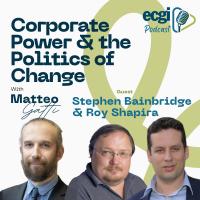
The Law of Corporate Governing with Stephen Bainbridge and Roy Shapira
Episode Summary
When a company halts sales of assault-style rifles, pulls advertising from a controversial platform, or whose CEO takes to social media with a political opinion — is any of it legal? And if it goes wrong, who's liable?
In this episode, host Matteo Gatti (Professor of Law at Rutgers Law School and author of Corporate Power and the Politics of Change) sits down with two leading corporate law scholars to map the actual legal terrain of corporate political engagement. Together, they work through the doctrine in law school fashion — hypotheticals, edge cases, and all — to find where the law gives boards genuine latitude, where it constrains them, and where the genuinely hard cases live.
Stephen Bainbridge (UCLA School of Law) makes the case for shareholder wealth maximisation as both the law of the land and what the law ought to require. Roy Shapira (Reichman University, ECGI) brings a complementary lens, examining what happens when boards fail in their oversight duties — and whether ESG commitments, when they go wrong, can generate real legal exposure.
Stephen M. Bainbridge is the William D. Warren Distinguished Professor of Law at UCLA School of Law. He is the author of several books on corporate law and governance, including The Profit Motive (Cambridge University Press), a defence of shareholder wealth maximisation in an era of stakeholderist advocacy.
Roy Shapira is Professor of Law at Reichman University, Mehrotra Visiting Professor at BU Business and Research Member of ECGI. His scholarship sits at the intersection of corporate law, litigation, and reputational markets. He is also a co-author with host Matteo Gatti on ongoing work about ideological shareholder litigation.
Matteo Gatti is Professor of Law at Rutgers Law School, where he writes on corporate power, governance, and political economy. He is a Research Member of ECGI and the host of this podcast.
Key Topics Covered
Shareholder Primacy vs. Director Discretion The conversation opens with the foundational tension in corporate law: the standard of conduct (shareholder value maximisation, rooted in Dodge v. Ford and Newark, the Delaware Craigslist decision) versus the standard of review (the business judgment rule). Bainbridge explains that while maximising shareholder value is what directors are expected to do, courts will almost never second-guess a board that can articulate a rational business justification — meaning the business judgment rule does most of the heavy lifting in practice.
Constituency Statutes and Their Limits Many US states have constituency statutes permitting boards to consider employees, communities, and other stakeholders. But as Bainbridge notes, fewer than 40 cases have ever been decided under these statutes, and none clearly spell out how they change the shareholder primacy norm. In the context of corporate political engagement, the practical outcome is likely the same regardless of jurisdiction: courts will not review the decision.
Board-Authorised Political Speech vs. Rogue CEOs Shapira draws an important distinction: board-authorised political or social speech generally enjoys the same presumption of validity as any other business decision. But a CEO acting unilaterally — making incendiary statements without board oversight — opens a different line of potential liability under the Caremark doctrine. Courts won't expect boards to monitor every social media post, but a unique set of facts could give rise to a failure-of-oversight claim.
Working Through the Hypotheticals
- Dick's Sporting Goods and gun sales — The board's decision to halt assault-rifle sales and raise the purchase age for firearms is an easy case for business judgment rule protection. Deciding what products to sell is core board territory, and the decision was rationally connected to long-term profitability.
- The pharmacy and religious convictions — A publicly traded company whose controlling family stops stocking emergency contraception for religious reasons faces a harder question. Having chosen to go public as a for-profit corporation, the board cannot simply confess indifference to profit without triggering Craigslist-style liability. The contrast with Chick-fil-A (a private company with a long-established, publicly known value proposition) is instructive.
- The logistics company and the vaccine mandate — A board that consciously decides to violate a federal regulatory requirement — while holding a legal memo explicitly outlining that requirement — faces potential Caremark exposure. This falls squarely in the line of cases (including Massey) where a board profits off flouting regulation it knows about.
- The advertising boycott — Pulling advertising from a platform whose algorithm amplifies extremist content looks much more like protected corporate socioeconomic advocacy, easily framed as a long-term brand protection decision. Courts are not well-positioned to second-guess that judgment.
Caremark Liability and ESG Risks Shapira explains that Caremark oversight liability hinges on whether a specific ESG issue is critical to the company's business. Governance risks (e.g. cybersecurity) are more likely to trigger it; environmental risks (e.g. climate change) are harder to connect causally to corporate harm. Political risks are generally more transient and harder to anticipate — meaning they will rarely give rise to oversight liability, absent a very specific set of facts.
Bainbridge raises the concern that an expansive Caremark doctrine sits in tension with the business judgment rule: shareholders want boards to take risks, not just manage them. He notes an emerging split on the Delaware Chancery Court, with Chancellor McCormick and Vice Chancellor Laster taking a more expansive view of Caremark while Vice Chancellor Will has reaffirmed that it should remain the most difficult theory on which a plaintiff can succeed.
Policy Implications and Practical Advice All three agree the law is broadly in the right place — courts should not be second-guessing boards on corporate political strategy. For practitioners, Shapira's one-word recommendation is: document. Boards that can show they received information, deliberated, and followed up will generally satisfy the Caremark standard even if a decision turns out badly. Gatti adds that stakeholders reward transparency and consistency — companies that articulate how and when they will engage on political issues fare better than those who chase political trends opportunistically.
Links
- The Profit Motive by Stephen Bainbridge (Cambridge University Press 2023)
- Corporate Power and the Politics of Change by Matteo Gatti (Cambridge University Press)
- Director Primacy: The Means and Ends of Corporate Governance, by Stephen Bainbridge (97 Nw. U.L. Rev. 547, 573 (2003))
- The Business Judgment Rule as Abstention Doctrine, by Stephen Bainbridge (57 Vand. L. Rev. 83, (2004))
- Mission Critical ESG and the Scope of Director Oversight Duties by Roy Shapira (2022)
- Conceptualizing Caremark by Roy Shapira (2024)
- Dodge v. Ford Motor Co., 170 N.W. 668 (Mich. 1919)
- eBay Domestic Holdings, Inc. v. Newmark, 16 A.3d 1 (Del. Ch. 2010)
- In re Caremark International Inc. Derivative Litigation, 698 A.2d 959 (Del. Ch. 1996)
- Shlensky v. Wrigley, 237 N.E.2d 776 (Ill. App. Ct. 1968)
- Strategic CEO Activism in Polarized Markets by Shubhashis Gangopadhyay and Swarnodeep Homroy (2020)
-
Saints and Sinners: How Does Delaware Corporate Law Work? by Edward Rock (1996)
Other Episodes
-
Corporate Governing and the Role of Shareholder Primacy with Ann Lipton – ep. 4 in Corporate Power and the Politics of Change with Matteo Gatti
Corporate Power and the Politics of Change is an ECGI podcast. All episodes are available on the ECGI website and wherever you listen to podcasts, including YouTube.
Connect with us:
Speakers