
The ECGI blog is kindly supported by

The Motherhood Penalty Beyond Performance
Authors

Women remain underrepresented in senior investment roles, and the birth of a child is one of the moments where careers between men and women most visibly diverge. Whether this reflects a genuine performance change, an employer response to expected changes, or something else has been difficult to establish because output is rarely measured with enough precision to sit alongside career outcomes and be compared directly. Fund management is an exception. Manager assignments, leadership positions, and investment returns are all observable, which makes it possible to track both what happens to performance and what happens to careers around childbirth, and to ask whether one explains the other.
Our study of China's open-ended mutual fund industry between 2006 and 2024 does exactly that.
China's mutual fund regulations require companies to report manager absences exceeding 30 days and state the reason. By manually reviewing these filings across a sample of 14,353 funds and 6,080 managers, we identify 962 maternity leave events. Women account for 22.8% of managers in mutual fund firms. The disclosure data allow us to infer pregnancy periods, observe leave and return dates, and track careers and fund performance before and after childbirth with unusual precision.
The Career That Does Not Recover
After childbirth, female fund managers who remain in the industry are significantly less likely to hold leadership positions. Conditional on staying in the mutual fund industry, the number of leadership positions held declines by around 26%. Investment responsibilities, as measured by normalized assets under management, fall by 38% relative to the mean. Industry participation tells the same story: new mothers are 42% less likely to remain active in the mutual fund industry after childbirth.
These estimates compare new mothers to co-managers who jointly oversaw the same fund immediately prior to childbirth, holding constant fund-level conditions and investment opportunities. Selection is unlikely to drive these results: fertility timing is unrelated to prior investment performance, and managers who return after maternity leave are broadly similar to those who do not in terms of pre-birth characteristics and performance.
These are not short-run disruptions. Three years is long enough to capture any adjustment period, and the gaps do not narrow. Mothers retain industry roles but receive fewer senior assignments and less investment responsibility years after returning to work.
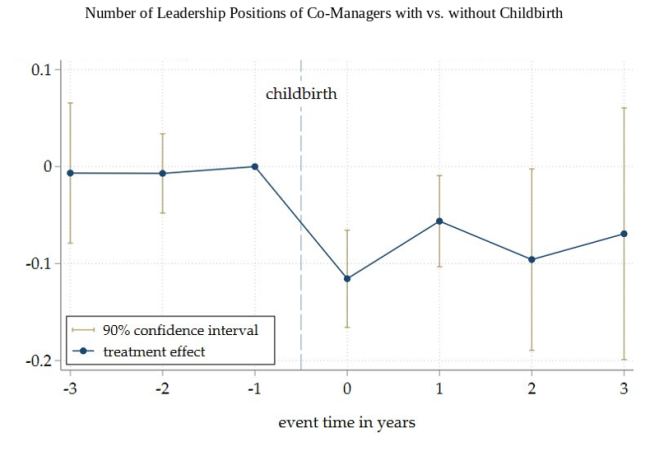
Figure 1: The Motherhood Penalty on Leadership Positions
The performance evidence follows a different pattern. To ensure comparability in fund characteristics, each affected fund is matched to two control funds of the same type, style, and similar size and age. For single-managed funds, where the affected manager carries direct responsibility, abnormal returns decline during pregnancy and the first six months after return. The annualized decline is around 2.0 to 2.5 percentage points in the matched-sample analysis. This is a real and measurable cost.
It is also temporary. From six to thirty-six months after return, performance no longer differs from pre-pregnancy levels or from matched peers. Team-managed funds show no comparable decline at all, which suggests the effect depends partly on how investment responsibility is organized. When it is shared, the temporary constraint on one manager's capacity does not produce the same outcome.
The mechanism evidence points to information acquisition. During pregnancy, managers reduce on-site corporate visits by around 50%. Since company visits are a channel for acquiring firm-specific information, their reduction is consistent with the timing of the performance decline. There is also some evidence of lower non-market return variation, suggesting less active portfolio management, while total portfolio risk is unchanged.
Two Separate Stories
The most important test is the last one. Managers with larger performance declines around childbirth are no more likely to exit the industry, lose leadership positions, or see their investment responsibilities reduced afterward. The same holds for managers with strong pre-birth track records: top performers before childbirth experience a motherhood penalty of similar magnitude to other managers. Short-run underperformance does not predict the persistent career penalty. The two patterns, temporary performance cost and durable career setback, are statistically and economically separate.
This separation is the paper's central contribution. Persistent career differences in high-skill labor markets are often attributed, at least in part, to performance changes following disruptions. Here, measured performance returns to normal within months while career trajectories do not follow. The paper does not resolve whether the long-run penalty reflects employer expectations, organizational inertia, or changes in how mothers are assigned to funds and teams. But it rules out sustained underperformance as the central explanation, and in doing so shifts attention from the measurement of output to the allocation of opportunity.
______________
Larissa Ginzinger is a Ph.D. candidate at the University of Mannheim.
Kun Li is a Lecturer of Finance at the Australian National University (ANU).
Alexandra Niessen-Ruenzi is Professor of Finance at the University of Mannheim in Germany, and an ECGI Research Member.
Gang Wang is an Associate Professor (without tenure) at the School of Accountancy, Shanghai University of Finance and Economics.
This blog is based on a paper presented at the 4th HKU Summer Finance Conference. Visit the event page to explore more conference-related blogs.
The ECGI does not, consistent with its constitutional purpose, have a view or opinion. If you wish to respond to this article, you can submit a blog article or 'letter to the editor' by clicking here.