The 2026 Wallenberg Lecture: "Can We Stop Climate Change?"
Author
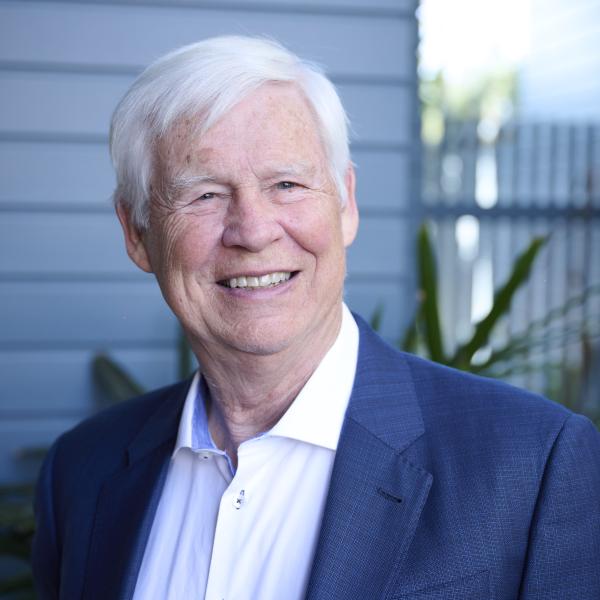

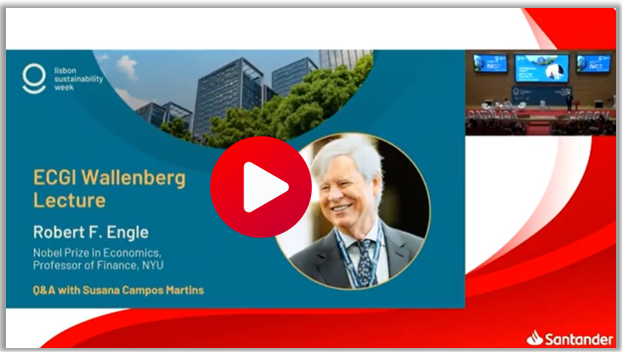
The 2026 ECGI Wallenberg Lecture, "Can We Stop Climate Change?" was delivered by Nobel Laureate Robert F. Engle, Emeritus Professor of Finance at NYU Stern at Santander Center, Lisbon, Portugal on Tuesday, June 30, 2026.
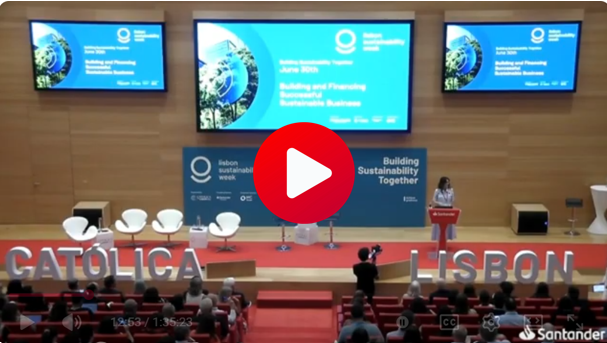
Opening remarks were by Inês Rocha de Gouveia, President of Fundação Santander Portugal, welcoming attendees to the Santander Center in Lisbon.
The session was formally opened by Isabel Capeloa Gil, Rector of Universidade Católica Portuguesa, on behalf of Católica-Lisbon School of Business and Economics.
The keynote was introduced by Susana Campos-Martins (Católica-Lisbon SBE and University of Oxford), with additional remarks on the history of the Wallenberg Lecture — a collaboration between Católica-Lisbon and the European Corporate Governance Institute (ECGI) from Marco Becht, Professor of Finance and Executive Director of ECGI.
In the lecture, Robert F. Engle, recipient of the 2003 Nobel Prize in Economic Sciences and Professor of Finance at NYU Stern, Co-Director of the NYU Stern Volatility and Risk Institute, asks whether the world can, and will, stop climate change. Drawing on research from the Volatility and Risk Institute, he examines how financial markets price climate and "termination" risk, how fossil-energy and sustainable-investment portfolios have performed, and what recent policy and geopolitical shifts mean for the path to net zero. He closes with a personal reflection on hope for the future. A moderated Q&A follows, covering global climate politics, energy security trade-offs, and overlooked environmental risks.
This lecture was part of Lisbon Sustainability Week 2026, a multi-day platform for collaboration between policymakers, business leaders, investors, academics, and innovators working to turn sustainability ambition into implementation.
📍 Santander Center, Lisbon, Portugal
📅 Tuesday, June 30, 2026

Video Timeline Summary
Introducing the lecture
- Inês Rocha de Gouveia welcomes attendees to the Santander Center, and Isabel Capeloa Gil formally opens the session on behalf of Católica-Lisbon SBE.
- Susana Campos-Martins introduces Robert Engle, highlighting his Nobel-winning work on time-varying volatility and his more recent research on systemic, geopolitical, and climate risk.
- Marco Becht traces the history of the ECGI Wallenberg Lecture and its collaboration with Católica-Lisbon.
Framing the Question
- Engle opens with the question "Can we stop climate change?" — answering that yes, we can, but the harder question is whether we will.
- He sets out to test this using market data rather than only policy analysis, drawing on research from the NYU Stern Volatility and Risk Institute.
- Three threads follow: how markets price climate risk, a new concept he calls termination risk, and what has changed in policy and geopolitics since November 2024.
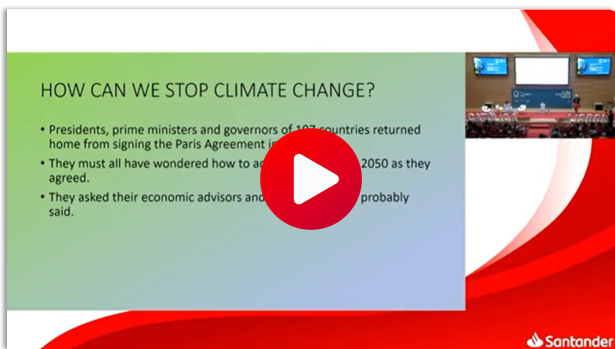
Government choices and free riders
- Climate change is an externality — those who suffer the damage are not those who cause it — so markets cannot solve it alone and free riders benefit from action they never take. Government intervention is unavoidable.
- Governments broadly have four tools, and different ones may suit different countries: carbon taxes, which Engle rates as effective in the EU's ETS; renewable subsidies, the U.S. approach, since eroded; direct regulation of emissions and energy-hungry products; or simply "hope" that employees, investors, CEOs, and shoppers each choose the greener option and that this adds up to net zero.
- Economists are skeptical hope works alone, due to the free-rider problem — but that is exactly where the world started, with no policy at all, and the open question is whether anything better replaces it.
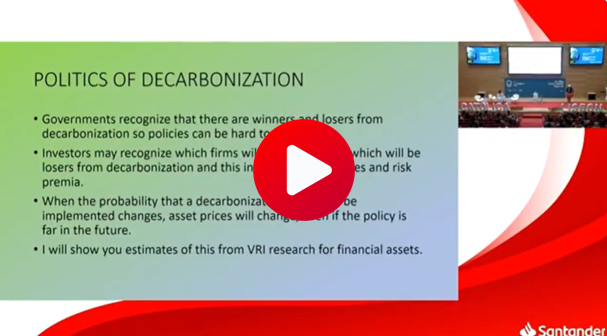
Pricing decarbonization risk
- Because decarbonization creates winners and losers, investors betting on them are really betting on how much decarbonization the political system will deliver, and that uncertainty is priced in asset markets today.
- Engle explains how hedge portfolios (long green assets, short fossil assets) can measure the market's implied belief that decarbonization policy will actually happen. Held as insurance rather than as a bet, such a portfolio should carry a negative expected return unless the policy arrives.
- Applied to banks through NYU's public VLAB platform, which updates daily for around a thousand institutions, this shows most major banking systems currently have low, recently even negative, exposure to climate-related "stranded asset" risk.
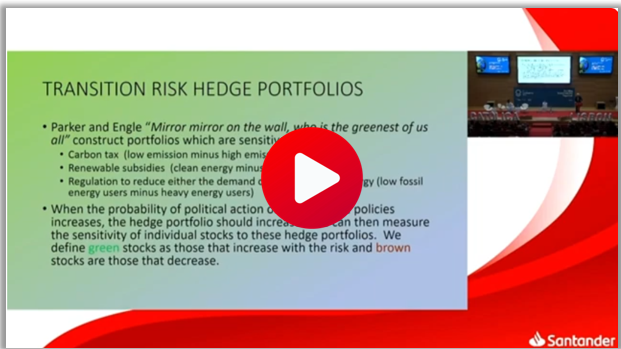
Green vs. brown stocks
- Engle defines green stocks as the winners under transition risk and brown stocks as the losers, judged by how they move with hedge portfolios rather than by intuition or ratings.
- Within the S&P 500, the market's greenest names are largely utilities active in renewables and electrification, while the brownest are energy producers and heavy industrials exposed to high fuel costs.
- Green firms tend to have high profit margins, high price-to-book ratios, low debt, high R&D, low emissions, and low volatility; brown firms show the opposite pattern. Notably, ESG scores themselves are not statistically significant predictors: the market appears to price actual emissions, not ESG ratings.
Termination risk
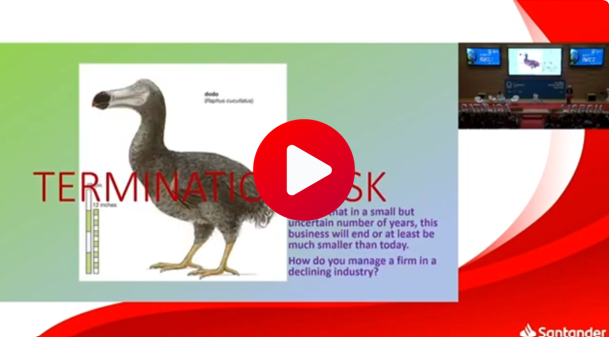
- Engle introduces "termination risk", the risk that a company's business model faces extinction, using the dodo and a fictional beachfront hotel as illustrations.
- The rational owner of a doomed hotel stops expanding, cuts investment and maintenance, and harvests cash instead. If rivals do the same, shrinking supply can lift prices and make profits look strong.
- Such a firm is still worth the present value of its cash flows until termination. Predicted signatures include low P/E and price-to-book ratios, high dividends and buybacks, low long-term debt, and consolidation rather than diversification.
Testing it on fossil fuels
- Under a Paris-consistent pathway the fossil business trends to zero, and the underlying data make that plausible: coal is declining, petroleum is past its peak, renewables are rising from a low base, though natural gas is still growing.
- Fossil energy stocks show exactly these signatures: lowest sector P/E and price-to-book ratios, highest dividends, lowest debt, sharply reduced drilling investment, and a wave of consolidation (ExxonMobil and Pioneer, Chevron and Hess) rather than expansion. Selling to a competitor is itself a way of terminating a company.
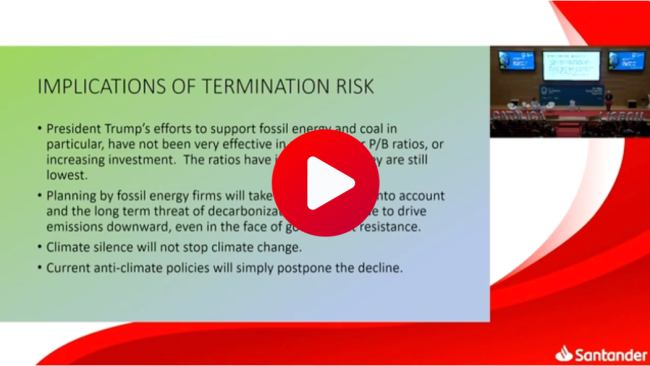
- Engle argues Trump-era support for fossil fuels has done little to reverse these trends, and that such policies can postpone the sector's decline but not prevent it. As he puts it, "climate silence will not stop climate change."
Markets vs. policy
- Because firms plan around termination risk regardless of Washington, the long-term threat of decarbonization keeps pushing emissions down even in the face of government resistance.
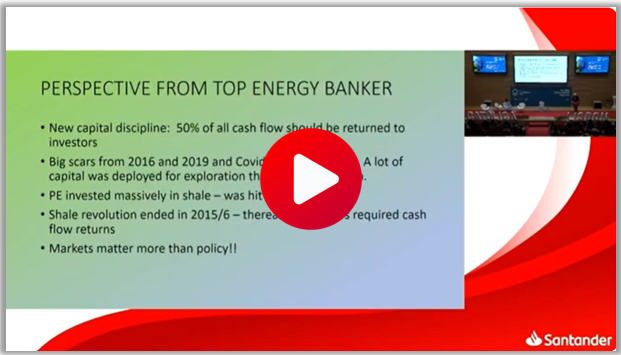
- A Houston energy banker's view: capital discipline now requires returning 50% of cash flow to investors, scarred by years of exploration spending that found little, and "markets matter more than policy."
Sustainable investing performance
- Sustainable funds returned ~27% in Trump's first year in office and were tracking ~30% by mid-2026 despite policy headwinds, driven by strong performance in lithium, hydrogen, and clean-tech ETFs, with the leading funds returning well over 100%.
- Higher oil prices helped producers less than they hurt the oil-consuming companies these funds hold short or underweight.
- The five-year picture is far weaker, with only a small minority of funds beating the market, so this is a story about one exceptional year rather than a settled trend.
Global politics and the path forward
- Engle argues the U.S. has become a climate "free rider": everyone gains by cooperating, but each country has a private incentive to defect, and no world government can enforce the outcome.
- Decarbonization no longer depends on cooperation, though. Cheap renewables, AI's power demand, and volatile fossil prices are driving it anyway, making it an opportunity rather than a cost and leaving free riders paying more.
- China's buildout is his model: solar parks larger than Manhattan powering high-speed rail, electric vehicles, and exports.
Q&A
- Discussion covers divergent national strategies, the EU's Carbon Border Adjustment Mechanism, decarbonization speed versus energy security (citing the 2025 Iberian blackout), and whether biodiversity loss and pollution are under-measured relative to carbon.
- On energy security Engle argues the trade-off runs the other way: after the Strait of Hormuz, no country wants to bargain for energy when the other side knows it has no choice, which makes renewables more attractive.
- What gives him hope, he closes, is that businesses keep decarbonizing regardless of shifting U.S. policy.