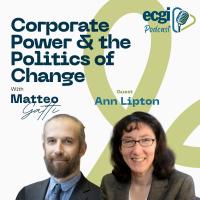
Corporate Governing and the Role of Shareholder Primacy with Ann Lipton
Episode Summary
Delaware courts have written that shareholders are the only corporate constituency whose interests are an end rather than merely an instrument of the corporate form. Taken literally, that sounds almost sociopathic — as if the law instructs boards to treat employees, communities, and the environment as tools. Ann Lipton argues that reading is wrong. What that language is actually doing, she says, is issuing a disclaimer: a signal that corporate governance cannot be trusted to exercise social control over corporations, and that the regulatory work must happen elsewhere. It is a cry for help.
In this episode, host Matteo Gatti (Professor of Law at Rutgers Law School and author of Corporate Power and the Politics of Change) sits down with Ann Lipton (University of Colorado Law School) to trace the legal architecture that made the ESG moment possible — and that made its unravelling, in some sense, inevitable. The conversation ranges from the legitimating logic of shareholder primacy, to the role of institutional investors as political actors, to Tornetta v. Musk and the dramatic transformation of Delaware law, to the question of whether any new legitimating narrative is now assembling to justify corporate power.
Ann Lipton is Professor of Law and Laurence W. DeMuth Chair at the University of Colorado Law School, and a Research Member of ECGI. She is one of the sharpest and most consistently provocative voices in corporate governance. She is also the host of the Shareholder Primacy podcast.
Matteo Gatti is Professor of Law at Rutgers Law School, where he writes on corporate power, governance, and political economy. He is a Research Member of ECGI and the host of this podcast.
Key Topics Covered
The Legitimating Function of Shareholder Primacy Lipton's core argument is that shareholder primacy was never simply a legal rule — it was a legitimating apparatus. Ever since the late nineteenth and early twentieth centuries, when giant private corporations first emerged, there has been a problem: these enormously powerful entities are controlled by a small handful of unelected individuals with no democratic accountability. Shareholder primacy was the solution the system settled on. It constrains corporate titans by requiring them to work for shareholders — and, crucially, it claims that doing so is pro-social, because a well-functioning regulatory system and competitive markets ensure that profits can only be earned in ways that benefit society. On this account, shareholders maximising wealth is not just permissible, it is good.
Delaware's role in this story is both central and self-interested. A small state with disproportionate control over US corporate law needs its own legitimating narrative. Delaware's claim to political neutrality — its insistence that it is a technocrat, not a policymaker — depends entirely on shareholder primacy itself being treated as apolitical. If maximising shareholder wealth is just an economic objective, then Delaware is not making social policy. It is relying on the rest of the legal and political system to do that.
The "Cry for Help" Reading of Delaware's Language When Delaware courts write that shareholders are the only constituency whose interests are an end rather than an instrument, the most charitable reading is not that other stakeholders don't matter — it is that corporate governance is the wrong place to protect them. Delaware is signalling: we need external law, external markets, and external regulation to ensure that profits can only be achieved pro-socially. That is not corporate governance's job. The problem is that when that external system fails or is captured, the whole architecture collapses.
Who Is Actually Doing the Work? Lipton agrees with Gatti that the formal legal rule — the fiduciary duty to maximise shareholder wealth — is not what actually enforces shareholder primacy in boardrooms. The real enforcers are executive compensation tied to stock performance, the social and reputational rewards of a rising share price, the risk of being removed by shareholders if directors fail to do so, and above all the cultural internalisation by boards of the idea that their job is to increase wealth. Directors genuinely believe that wealth maximisation is both their obligation and good for society. The formal fiduciary duty doctrine is more of a public display than an operational constraint.
Why ESG Was Always Structurally Fragile The stewardship theory — the idea that large diversified institutional investors with long time horizons would naturally demand pro-social behaviour from their portfolio companies — assumed that shareholder primacy works: that pro-social behaviour would in fact be profitable. But institutional investors are not free actors in a politics-free space. They are regulated entities, and their regulators can and do tell them what "wealth maximisation" requires. Democrats said climate change reduces long-term returns, so institutional investors have a fiduciary duty to police it. Republicans say diversity reduces returns, so institutional investors have a fiduciary duty to oppose it. The moment the regulatory winds shifted, the entire ESG project of channelling investor pressure toward social outcomes became vulnerable to the same political forces that had blocked direct government action.
The Performative Nature of Corporate Political Engagement Boards have every incentive to prove that wealth maximisation leads to pro-social outcomes — that is the claim that justifies the whole system. So they will embrace diversity when regulators and consumers reward it, and abandon it when the regulatory winds change. Meta's journey from rainbow-flag buses to Zuckerberg's " masculine energy" and “aggression” pivot on the eve of Trump's second inauguration is Exhibit A. Disney's repeated back-and-forth with Republican officials is another. The commitments were never durable because they were instrumental, not principled.
Tornetta v. Musk and the Unmasking of Delaware Lipton frames the Tornetta litigation — the challenge to Elon Musk's $56 billion Tesla compensation package — as a moment that "gave the game away." Delaware's procedural requirements for cleansing self-interested transactions (running them through independent directors, seeking shareholder votes) were always, on Lipton's account, partly performative: a public display designed to show that even the most powerful corporate actors have to comply with something. Tesla's board didn't bother with even a pantomime of compliance — and yet Tesla shareholders thrived. Chancellor McCormick got the law right, Lipton argues. But that was precisely the problem: it became very hard to square Delaware's formal requirements with the concrete fact that shareholders hadn't needed them. The guardrails were doing something other than what they claimed to be doing. Delaware's rapid legislative response — rewriting its law to make cleansing dramatically easier — confirms the point. The new rules look elaborate but impose almost no real constraint.
The Coordinated Assault on Shareholder Power Lipton offers a detailed account of the rolling institutional reversal on ESG and shareholder voice. Her key analytical move is to distinguish two things that have become entangled: attacks on ESG specifically (driven by political opposition to climate and diversity goals), and a much broader project of insulating boards from shareholder discipline, which uses ESG as its justification. The two have become mutually reinforcing. Institutional actors involved include ERISA regulators, the SEC, state attorneys general, conservative state legislatures, and the courts. Measures range from restrictions on proxy advisors and asset managers, to new barriers to shareholder proposals, to the effective elimination of quarterly reporting requirements, to encouragement of mandatory arbitration bylaws that would block shareholder class actions. ESG, Lipton argues, is the camel's nose through which shareholder power more broadly is being curtailed.
What Will Stick Lipton's prediction for what will prove durable regardless of future political change: the transformation of proxy advisors and mutual fund companies away from making voting recommendations and toward pure research and pass-through voting. Once the infrastructure for that model is built, there will be little incentive to reverse it — and the effect will be a structural fragmentation of the shareholder voice that has been the main accountability mechanism for corporate boards.
Is There a New Legitimating Narrative? Lipton's closing observation is her most unsettling. Her fear is that corporate boards now feel so politically protected — so confident in their cosy relationships with politicians — that they no longer believe they need a legitimating narrative at all. They don't feel they need a social licence to operate. The Delaware legislative episode, and the response of companies that faced unfavourable court decisions (announcing moves to Texas rather than committing to do better), suggests boards feel they simply will not be regulated. Whether that confidence is warranted is a question time will answer.
Links
- Corporate Power and the Politics of Change by Matteo Gatti (Cambridge University Press)
- The Legitimation of Shareholder Primacy by Ann Lipton (2025)
- Shareholder Primacy podcast hosted by Ann Lipton and Mike Levin
- Why Shareholder-Driven Corporate Social Responsibility Failed by Mark Roe (2026):
- Tornetta v. Musk, C.A. No. 2018-0408-KSJM (Del. Ch. Jan. 30, 2024)
Other Episodes:
- The Law of Corporate Governing with Stephen Bainbridge and Roy Shapira - Ep.1 in Corporate Power and the Politics of Change with Matteo Gatti
- Corporate Values Versus Value with Jill Fisch and Tim Smith - Ep. 3 in Corporate Power and the Politics of Change with Matteo Gatti
- The Economics of Corporate Governing with Swarnodeep Homroy and Elizabeth Kempf - Ep. 2 in Corporate Power and the Politics of Change with Matteo Gatti
Corporate Power and the Politics of Change is an ECGI podcast. All episodes are available on the ECGI website and wherever you listen to podcasts, including YouTube.
Connect with us: