The ECGI blog is kindly supported by
Political Risk Does Not Live at the Border
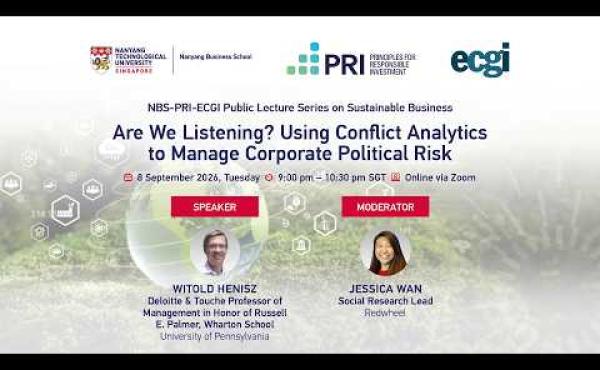
A review of the lecture “Are we listening? Using conflicts analytics to manage corporate political risk” by Professor Witold Henisz, Vice Dean and Faculty Director of Wharton Impact and Deloitte & Touche Professor of Management, 8th September 2026.
A solar project in the Moroccan desert had everything in its favour. Morocco is on track to produce more than half its power from renewables, and sits low on the major political risk scores. What those scores did not carry was that solar needs water as well as sun, to clean sand from the panels and cool equipment, and the places with both are where subsistence farming happens. Security walls cut farmers off from communal land, roads and water. They protested and went to court.The question left with the audience was which story would carry an investment committee: the miracle in the Sahara, or the small, discordant voices of the farmers.
The lecture's argument was that political risk does not live at the level of the country. It lives where a firm's operations meet local grievances, and indicators built on national averages cannot see it.
This was the fourteenth public lecture in the NBS-PRI-ECGI series, given by Witold Henisz, Deloitte and Touche Professor of Management in Honor of Russell E. Palmer at the Wharton School, University of Pennsylvania. It drew on almost three decades of work on political risk and on the Business and Conflict Barometer, a project of the past five or six years. Jessica Wan, Social Research Lead at Redwheel, moderated and offered the investor's perspective.
The grammar of conflict
Country indicators are not useless, but they are a retrospective average of prior events rather than a leading indicator, which makes them a poor guide to where risk lands next quarter. Henisz's proposal is to keep the country score but demote it from answer to prior. The alternative unit of analysis becomes a question rather than a score: how does one group (residents, a union, a ministry, an ethnic group, a set of firms) feel about another over an issue the firm touches, such as land, water, jobs, corruption, security, status or cultural recognition, in a particular place and time? Which relationships are deteriorating or improving, and how might the firm's perceived responsibility for the shift affect cash flows?
Mozambique shows what happens when that question goes unanswered. Development lenders saw offshore gas lifting one of the world's poorest countries to middle-income status, with the government expecting almost 100 billion dollars. Residents said the benefits were not reaching them. An attack by an ISIS-linked militant group, which drew sympathy from local villagers, produced force majeure and a halt to construction that took TotalEnergies 4.5 years to reverse, with efforts to rebuild the social license still ongoing. Financial losses from such conflict are measurable and widespread: research with Doron Tadmor, published in Resources Policy, estimated the cost of 28 Indigenous-rights mining conflicts in Peru at about $32 billion, most of it lost productivity.
The Barometer makes this observable at scale: more than five billion news articles from 2015 to 2024 have yielded 50 billion extracted events of the form group X is angry or pleased with group Y about an issue, each geolocated, which allows analysis at the level of a gas field rather than a country. Within Kuwait, Glencore attracts very negative sentiment and Microsoft very positive.
"Political risk doesn't exist at the level of Kuwait; it exists at the level of Glencore's operations and Microsoft's operations in Kuwait."
Money as accelerant
Grievance in the news predicts riots, violence, and deaths in the following quarter and years, and overlapping grievance by the same groups in one place predicts it most strongly. On average, an IFC-funded project contributes to conflict despite the due diligence, as does the average solar project in a conflict-sensitive state. A billion dollars of capital expenditure and a thousand jobs do not automatically improve a place. Their distribution of benefits to costs across groups with pre-existing grievances and the capacity to mobilize for conflict decides that.
The same data separates the projects that work. Concentrating on a narrow group of politically connected elites moves a project faster through decision gates and into construction, and also faster into conflict. Inclusive projects, which adjust their priorities as local issues shift, see less violence.
Three that changed who decides and saw less conflict
Newmont's Ahafo gold mine in Ghana handed decisions over community spending to a forum of community, traditional and women's groups, funded by one per cent of net profits plus a payment per ounce, so it earned more when the mine did. Chevron's foundation in the Niger Delta went further into regional capacity, and the people who ran it now win elections at local and national level. At BHP's Tintaya mine in Peru, where coercive land acquisitions by previous owners and allegations of abuse had spiralled into violent protest, local teams were given power to investigate; when a regional opposition party later tried to seize the mine, the Indigenous communities said they wanted it to keep operating.
From signal to action
Henisz argued that the same conflict signal reaches different asset classes via distinct pathways and timelines, and that giving three teams one dashboard is not integration. For equity, it works through cash flow and multiples: map the revenue at each site and the cost of adapting, then reprice, resize or engage. For corporate credit, it works through liquidity, covenants and recovery: stress-test how long a disruption could last and whether inputs can be substituted, then price or condition capital and seek disclosure. For sovereign credit, it works through fiscal capacity, security and market access: overlay political tone, trade dependence and alliances on the usual scores. In every case the tail matters more than the average. Rare, heavy losses, not typical controversy costs, are the underwriting problem.
Mandate shapes the response as well. A concentrated holder can map a site in depth, reach the board and set explicit milestones. An active diversified investor can look for gaps between signal, exposure, adaptive capacity and price. A sustainability or impact investor should test who gains, who bears the costs and whether remedy is real. A universal owner's lever is collective: common disclosure and shared data as public goods.
To triangulate, he suggested three layers of signal. The geopolitical layer covers public opinion towards foreign powers, alliances, tariffs and sanctions. The external stakeholder layer covers geolocated group–issue events from the Barometer and expert judgement. The internal layer covers grievances, procurement, hiring and community sentiment. Stewardship teams should also ask companies for concrete examples of how conflict management works: who is in the room, who leads, and how costs and benefits are shared across functions as well as with stakeholders.
The view from the investor’s desk
The commentary from Jessica Wan described a gap, where conflicts are rising in number and severity, and exposure has spread beyond oil, gas and minerals into tech. Yet in public equity the method is a sanctions list and an exclusion list, applied at country or stock level and triggered only after an event reaches a headline. Conflict is handled as a binary, usually a yes or no in a spreadsheet. A called-for answer is a qualitative readiness tool built around engagement rather than exclusion, because "when we exit a position, we lose all power." It cannot, however, run across ten thousand holdings.
- Is there a disincentive to look, when finding a risk creates an obligation to act?
The slippery-slope worry may hold for a quarter, but the unmapped grievance returns as a roadblock, strike or held-up permit. An early study of 28 single-purpose entities listed in Toronto, each owning one mine and hoping to flip it to a major, found more than 72 per cent of share value tied to how stakeholders perceived it.
- How much delay is acceptable in order to manage community grievances?
An extra year or two is never popular, but the alternative can be five or ten years of suspension, or the Bougainville mine in Papua New Guinea, which triggered a civil war that killed a tenth of the island's population and remains undeveloped. With an overwhelming share of critical minerals sitting on or beside lands claimed by Indigenous populations, rushed development leaves the forecasts for lithium and gallium without foundation.
The closing move scaled past any single portfolio. If the IFC and foreign investors in solar are getting this wrong on average, system-level growth forecasts are wrong too. The precedent is familiar: warning signs around mortgage-backed securities were visible long before prices collapsed, and those with most at stake acted only afterwards. Whether today's signals are enough to move universal owners before the next Minsky moment was left open, though not neutrally: Henisz suggested that they are "not living up to their responsibility to address systemic risks." A harder question sits underneath. Country managers report that doing the patient thing gets them penalised by investors, which makes educating investors, and not only companies, part of the work.
-----------------------------------
This lecture is part of the NBS-PRI-ECGI Public Lecture Series, a global initiative on sustainable business. Nanyang Business School (NBS), in collaboration with the Principles for Responsible Investment (PRI) and the European Corporate Governance Institute (ECGI), launched this series to foster knowledge exchange between academics, practitioners, and policymakers. As part of this initiative, leading academics present cutting-edge research on sustainability topics, while industry experts moderate discussions, providing real-world insights and facilitating dialogue between research and practice.