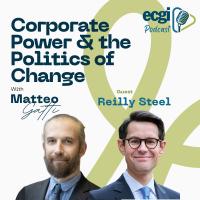
Politics in Corporations: Systematic Corruption with Reilly Steel
Episode Summary
Citigroup imposes gun purchase rules stricter than most state laws. Disney fights the Florida governor over legislation. Corporations, for a decade, decided they had something to say about politics. But something else has been happening in the opposite direction: Paramount's backers called the White House when competing for a merger approval. Palantir's CEO publicly embraced the current administration while his company's federal contracts expanded. This is not corporations shaping politics — it is politics shaping corporations, rewarding loyalty and manufacturing dependence.
Reilly Steel's new paper "Systematic Corruption" maps the structural logic of that second dynamic. His argument is that what looks like political pressure on business is in fact a recognisable historical pattern — one that defined much of the early American republic and that earlier generations of reformers worked hard to dismantle. The conversation covers both the diagnosis and the reform toolkit, then turns to Steel's empirical work documenting the ideological transformation of American corporate elites over the past two decades — data that helps explain why corporations moved left on social issues, and what their recent retreat tells us about the limits of ideology as a driver of corporate behaviour.
Reilly Steel is Associate Professor of Law at Columbia Law School, where he works at the intersection of corporate governance and political science. His article "Systematic Corruption" is forthcoming in the Columbia Law Review. His empirical article "The Political Transformation of Corporate America, 2001–2022" was published in the American Political Science Review (2025). His article "Lobbying Against Enforcement" is forthcoming in the Yale Journal on Regulation.
Matteo Gatti is Professor of Law at Rutgers Law School, where he writes on corporate power, governance, and political economy. He is a Research Member of ECGI and the host of this podcast.
Key Topics Covered
Opportunistic versus Systematic Corruption Steel opens with a conceptual distinction that anchors the entire paper. Opportunistic corruption is the familiar kind — a bag of cash for a legislative favour, policy decisions made while holding a concealed personal interest. The Bob Menendez and Eric Adams prosecutions are paradigm cases. Systematic corruption is different in kind, not just degree. It is the manipulation of economic privileges — corporate charters, government contracts, regulatory approvals, enforcement forbearance — by politicians to secure the political loyalty of recipients and thereby entrench themselves in power. The mechanism is a self-reinforcing cycle: political power generates economic privileges, economic privileges create dependence, dependence generates political support, political support entrenches political power. No individual transaction needs to be criminal. The corruption is in the system design.
The Historical Pattern: Albany Regency to Tammany Hall Steel traces the logic through 19th-century American history. Martin Van Buren's Albany Regency — the nation's first political machine — used bank and insurance charters, initial share offerings directed to party supporters, and government employment to build and sustain political control of New York state for two decades. What is now called the spoils system began here. The paper covers corporate chartering, government personnel, government contracts, and public debt across this era, with Boss Tweed's Tammany Hall as a later and more spectacular iteration. Steel notes the key lesson from Tammany: criminal prosecution of individual actors (Tweed was eventually prosecuted) did not dismantle the system. The problem was institutional, not personal, and subsequent bosses simply continued the practice.
Why the Current Moment Is More Dangerous Steel identifies four structural changes that make today's version of systematic corruption more alarming than its 19th-century predecessors. First, a dramatic growth in presidential power accompanied by unitary executive theory concentrates discretion in a single actor in ways that differ fundamentally from the era Woodrow Wilson called congressional government. Second, the erosion of inter-branch rivalry: where Madison envisioned ambition counteracting ambition, Daryl Levinson and Richard Pildes's concept of "separation of parties, not powers" describes the current reality, in which a president of one party faces little resistance from Congress controlled by the same party. Third, increased partisan sorting in the judiciary, exhaustively documented by John Kastellec and Chuck Cameron, means courts are a less reliable source of countervailing power. Fourth, and most relevant for corporate governance, the concentration of economic privileges at the federal level rather than dispersed across states makes systematic corruption more scalable — discipline can be coordinated nationally rather than state by state.
The Reform Toolkit: Three Principles from the 19th Century The paper identifies three principles that animated the successful reforms of the 19th and early 20th centuries, which Steel argues are universal and portable. The first is constraints on discretion — shifting from case-by-case decisions subject to political influence to rule-bound processes. General incorporation replacing special incorporation is the paradigm case: instead of legislators deciding which businesses deserve charters, standardised criteria apply to all. The second is insulation from partisan control — shielding decision-makers from partisan incentives through structures like independent agencies, where heads are not removable at will. The third is countervailing power — building rival centres of authority capable of contesting corrupt arrangements, whether through empowering interest groups, enabling interstate regulatory competition, or bringing citizens directly into policymaking. Steel is candid that applying these principles today is harder than in the 19th century, particularly insulation from partisan control given the current Supreme Court's hostility to agency independence, which requires thinking creatively rather than simply replicating historical reforms.
Presidential Immunity and the Pardon Power Gatti raises the compounding effect of Trump v. United States, in which the Supreme Court held that a president possesses absolute immunity for core constitutional acts and presumptive immunity for other official acts — with the pardon power itself being a core act. This means the actor directing systematic corruption may be effectively outside criminal law while simultaneously possessing the power to extinguish the criminal liability of an entire network around them. Steel's response is characteristically institutional: criminal prosecutions were never really the solution to systematic corruption. Tammany Hall survived Tweed's prosecution. The fix must be structural — civil law reforms, institutional redesign — not the removal of individual bad actors.
The Ideological Transformation of Corporate America Steel's empirical article in the American Political Science Review provides the quantitative backdrop to a central puzzle in Gatti's book: why did corporations take progressive positions on guns, climate, and LGBTQ rights that invited serious political backlash? Steel assembled data on the campaign contributions of 97,469 corporate directors and executives at 9,005 US companies from 2001 to 2022. The headline finding is that the average ideology of corporate leadership shifted meaningfully left over that period — from modestly conservative in 2001 to roughly centrist by 2022. But the aggregate masks important variation: the energy industry barely moved; the tech sector shifted substantially left; CEOs remain more conservative than senior managers below the C-suite; directors moved from a strong conservative skew to rough balance. The shift is driven primarily by generational turnover rather than individual conversion.
Leadership Ideology versus Stakeholder Pressure: The Disney Test The conversation uses the Disney/ABC/Jimmy Kimmel episode as a stress test for the causation question. Disney leadership (measurably liberal by campaign contribution data) initially suspended Kimmel from air following FCC pressure over ABC's broadcast licence, then reversed that decision after significant employee and consumer backlash. Steel interprets this as evidence that both leadership ideology and stakeholder pressure matter, but that the latter can override the former when the pressure is intense enough. His instrumental variables analysis — using the ideology of other firms in the same industry as a proxy to address selection concerns — finds that leadership ideology remains a significant predictor of corporate stances on LGBTQ issues even after controlling for employee ideology, though employee ideology becomes insignificant once leadership is included, suggesting leadership is the more proximate driver.
What Corporate America's Retreat Tells Us Steel updated his data through 2024 and finds no conservative retrenchment in the underlying ideology of corporate leadership — the leftward trend levelled off but did not reverse. Yet corporate actions have shifted right, most visibly in the mass retreat from DEI commitments. His reading is that the divergence between ideology and behaviour reflects firms responding to external political stimuli rather than a genuine change in the views of the people running them. This supports the systematic corruption frame: what looks like corporate political evolution is substantially a response to coercive pressure from the state.
Links
- Systematic Corruption by Reilly Steel, Columbia Law Review (forthcoming)
- The Political Transformation of Corporate America, 2001–2022 by Reilly Steel, American Political Science Review (2025)
- Lobbying Against Enforcement by Reilly Steel, Yale Journal on Regulation (forthcoming)
- Separation of Parties, Not Powers by Daryl Levinson and Richard Pildes, 119 Harvard Law Review 2311 (2006)
- Valuing Administrative Democracy by Brian Feinstein and Daniel Walters (2025)
- Corporate Power and the Politics of Change by Matteo Gatti, Cambridge University Press (2025)
Other episodes
- The Economics of Corporate Governing with Swarnodeep Homroy and Elisabeth Kempf - ep. 2 in Corporate Power and the Politics of Change with Matteo Gatti
- Corporate Governing and the Role of Shareholder Primacy with Ann Lipton - ep. 4 in Corporate Power and the Politics of Change with Matteo Gatti
Corporate Power and the Politics of Change is an ECGI podcast. All episodes are available on the ECGI website and wherever you listen to podcasts, including YouTube.
Connect with us: