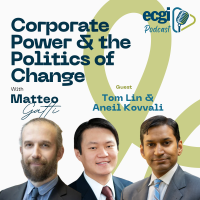
After the Retreat: Can Corporate Activism Return? with Tom Lin and Aneil Kovvali
Episode Summary
Corporate America spent a decade becoming an activist. It took sides on guns, climate, race, and voting rights. Some of it produced real change — the partial repeal of North Carolina's bathroom bill, the congressional ban on mandatory arbitration for sexual harassment claims, a federal Juneteenth holiday. Then, after the 2024 election, it stopped fast.
The reversal was not strategic; it appeared panicked, poorly coordinated, and in many cases created new legal and governance problems that companies hadn't anticipated — DEI language scrubbed from filings in ways that generated fresh disclosure risks, commitments abandoned without assessing what was owed to the employees and investors who had been told these were core corporate values.
In this episode, host Matteo Gatti (Professor of Law at Rutgers Law School and author of Corporate Power and the Politics of Change) revisits the case for corporate activism with two scholars who helped build it. Tom Lin (Temple University's Beasley School of Law) is the author of The Capitalist and the Activist, the most thorough account we have of how corporations and activists have learned to work together. Aneil Kovvali (Benjamin Cardozo School of Law) argued in "Stark Choices for Corporate Reform" that voluntary corporate action and external regulation are complements, not substitutes. Both are now reckoning with what the retreat reveals — and whether the case they made still holds.
Tom C.W. Lin is Professor of Law at Temple University's Beasley School of Law. He is the author of The Capitalist and the Activist: Corporate Social Activism and the New Business of Change (Stanford University Press), the leading scholarly account of how corporations and activist organisations interact and the conditions under which that relationship produces durable change.
Aneil Kovvali is Associate Professor of Law at Benjamin N. Cardozo School of Law. His article "Stark Choices for Corporate Reform" argues that voluntary corporate action and external regulation are complements rather than substitutes. He is also working on a new project, Corporate Resistance, examining the extent to which and conditions under which corporations have resisted or cooperated with the second Trump administration's agenda.
Matteo Gatti is Professor of Law at Rutgers Law School, where he writes on corporate power, governance, and political economy. He is a Research Member of ECGI and the host of this podcast.
Key Topics Covered
What Made the Successes Work Lin opens with the cases that actually produced change: #MeToo and the congressional ban on mandatory arbitration, North Carolina's HB2 and the partial repeal of the bathroom bill, Nike's Kaepernick campaign, the path from corporate Juneteenth recognition to a federal holiday. His diagnosis is alignment — when business action, social priority, and the political moment converge, corporate activism can produce a self-reinforcing flywheel effect where corporate and governmental efforts amplify each other. The commitments that reversed were the ones that lacked that alignment from the start.
Why the Retreat Happened — External and Internal Drivers Kovvali offers a systematic account. On the external side, the environment that made ESG flourish was one of governmental paralysis rather than governmental opposition: companies could act because there was no active political cost. The second Trump administration changed that calculus entirely — the government is now energetically pursuing a contrary agenda, and companies face real regulatory and legal exposure for acting differently.
On the internal side, Kovvali identifies two further dynamics. The first is an agency problem: a diversified shareholder's interests (fight unlawful government action, maintain systemic resilience) diverge sharply from those of a CEO whose entire human capital is concentrated in one company. Tim Cook striking a tariff deal is better for Apple than for the average Apple shareholder. The second is simple miscalculation — a widespread misreading of the 2024 election result as a fundamental shift in American values, rather than a standard incumbent-party backlash driven by inflation and post-COVID frustration. Target's retreat from its equality commitments, and the consumer boycotts that followed, is the clearest example of that misreading in practice.
The Retreat as a Governance Failure Gatti adds a dimension neither guest disputes: the reversal was not a carefully governed decision. Companies scrubbed DEI language from their filings in ways that created new disclosure risks. Programs were abandoned without assessing legal obligations to the employees and investors who had been told these were core commitments. Lisa Fairfax and Veronica Root Martinez have argued — and Gatti has discussed in a prior episode — that the retreat may prove to be a worse governance failure than the original advance.
Do the Pipelines Between Corporate Action and Legislation Still Exist? Kovvali argues the complementarity between internal corporate reform and external regulation still holds in principle — but can run in either direction. The Biden administration's strategy of directing green investment into red states through the Inflation Reduction Act is a live example of the virtuous cycle: government acts, corporations invest, private investment then constrains the ability of a subsequent administration to reverse course. Anthropic's public advocacy for AI regulation is another case where a single company's stance has shaped a broader public conversation, whatever one thinks of the motives.
But Kovvali is candid: the complementarity can also amplify in the wrong direction. Corporate cooperation with the Trump administration's agenda is itself a complementarity — each making the other more powerful — just not one that either guest would endorse.
Has Corporate Activism Lost Its Social Licence? Kovvali's most sombre note is about credibility. Companies that reversed their stated commitments at the first sign of political pressure will find it significantly harder to persuade employees and customers that any future activism is sincere rather than opportunistic. The cost-benefit calculation for corporations has shifted not just because of government pressure but because the credibility of corporate action as a form of principled commitment has been damaged. Future Republican administrations will remain a disciplining threat, meaning even under a subsequent Democratic government, companies may be reluctant to fully re-embrace DEI or climate commitments.
Lin is more circumspect, noting that corporate activism never went away — it shifted focus, and in a democratic capitalist system there are no permanent victories or permanent defeats.
Practical Advice for Boards Both guests close with concrete recommendations for corporations that want to engage on socioeconomic issues durably rather than performatively.
Lin's two points: first, embrace "better is good" — if you cannot achieve the best, pursue what is achievable within your own organisation and let peers and competitors follow. Second, focus on long-term enterprise prosperity rather than short-term political noise. A business that consistently serves its shareholders, employees, customers, and community is unlikely to be doing the wrong thing.
Kovvali's addition: just do it. The political risk of acting now is real — but it is also what makes action credible. Companies that act on principle when there is a genuine cost to doing so are the ones that will retain the trust of employees and customers when conditions improve. He also echoes Gatti's point that transparency matters: not new slogans, but clear communication about what a company is doing, why it matters to its stakeholders, and why it is prepared to hold the line.
Links
- Corporate Power and the Politics of Change by Matteo Gatti (Cambridge University Press 2025)
- The Capitalist and the Activist: Corporate Social Activism and the New Business of Change by Tom C.W. Lin (Berrett-Koehler Publishers , 2022)
- Stark Choices for Corporate Reform by Aneil Kovvali 2022 (Columbia Law Review, forthcoming)
- Corporate Resistance by Aneil Kovvali
- The Miscalculation of Corporate DEI Risk by Veronica Root Martinez and Lisa Fairfax, 2026 (University of Pennsylvania Law Review, forthcoming)
Related Episodes
- Dissecting the DEI Reversal with Veronica Root Martinez – ep. 5 in Corporate Power and the Politics of Change with Matteo Gatti
- The Limits of Private Sector-led Reform with Mark Roe – ep. 6 in Corporate Power and the Politics of Change with Matteo Gatti
- Corporate Governing and Shareholder Voice with Jill Fisch and Tim Smith – ep. 3 in Corporate Power and the Politics of Change with Matteo Gatti
- Dissecting the Architecture of Corporate Power with Elizabeth Pollman – ep. 10 in Corporate Power and the Politics of Change with Matteo Gatti
Corporate Power and the Politics of Change is an ECGI podcast. All episodes are available on the ECGI website and wherever you listen to podcasts, including YouTube.
Connect with us:
📱 Follow on YouTube | Spotify | Apple | Amazon