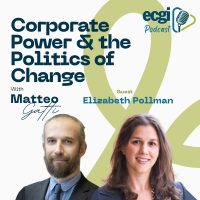
Dissecting the Architecture of Corporate Power with Elizabeth Pollman
Episode Summary
What is a corporation? Where is it? Whom does it serve? And who, in the end, governs it? These are not abstract philosophical puzzles — they are the questions on which the entire architecture of corporate rights and accountability rests. Elizabeth Pollman has spent two decades building frameworks that answer them, and each framework has become a term of art the field now depends on: the derivative nature of corporate constitutional rights, the pro-business paradox, the corporate governance machine, and most recently, the engines of external governance.
In this episode, host Matteo Gatti (Professor of Law at Rutgers Law School and author of Corporate Power and the Politics of Change) traces Pollman's intellectual arc from corporate personhood through Citizens United, from the Supreme Court's treatment of multinational corporations through the rise and fall of ESG, and from the machine that converts social concerns into shareholder value to the nonprofits — left and right — that feed it from outside. The conversation ends where the hardest questions now live: in the uncharted governance territory of frontier AI.
Elizabeth Pollman is the Perry Golkin Professor of Law at the University of Pennsylvania Carey Law School, co-director of its Institute for Law and Economics, and a Research Member of ECGI. She is one of the most influential corporate law scholars of her generation.
Matteo Gatti is Professor of Law at Rutgers Law School, where he writes on corporate power, governance, and political economy. He is a Research Member of ECGI and the host of this podcast.
Key Topics Covered
Corporate Personhood and the Derivative Approach Pollman opens with the foundational question: what constitutional rights do corporations have, and why? Working with Margaret Blair, she traced two centuries of Supreme Court jurisprudence to show that the Court has never given a corporation rights in its own right. It grants them either derivatively — to protect the natural persons the corporation represents — or instrumentally, to protect people outside the corporation. The problem is that the "associations of persons" metaphor the Court has long relied on fitted most corporations reasonably well in the nineteenth century, when firms were few, small, and closely held. It fits almost none of the dominant corporate forms today — giant publicly traded companies with millions of shifting, indirect shareholders, many of whom are not individuals or citizens at all. By continuing to reach for this metaphor, the Court can avoid the real question: whose rights are actually at stake?
Citizens United and the Voluntariness Problem Pollman saw the danger before Citizens United was decided, publishing a short essay in the Yale Law Journal online edition in time to influence — and ultimately fail to influence — the outcome. The Court's reasoning assumed that dissenting shareholders could use corporate democracy to constrain corporate political speech. Pollman's response is what Gatti calls devastating in its simplicity: most shareholders hold stock indirectly through index funds, pension funds, and mutual funds, with no real information about or voice over the political expenditures of the underlying companies. Index fund shareholders cannot exit without abandoning their strategy. Pension holders are structurally locked in. Fiduciary accountability was not designed for this. And the disclosure regime Justice Kennedy assumed in Citizens United — which might have allowed some external accountability — was never built, and has since been made constitutionally more vulnerable by Americans for Prosperity.
The Supreme Court and the Pro-Business Paradox In her Harvard Law Review piece, Pollman identifies a recurring pattern across three very different areas of law — First Amendment speech rights, personal jurisdiction, and human rights liability under the Alien Tort Statute — in which the Court reaches for a thin or ill-fitting conception of the corporation to expand corporate rights or shrink corporate accountability. The Nestlé case is the clearest example: the Court dismissed corporate decision-making at US headquarters as merely "general corporate activity common to most corporations" — sidelining the very thing that corporate law treats as definitional. A cardinal principle of corporate law is that the board manages the corporation through decision-making, and corporate statutes do not care where directors are physically located when they make a decision. To fixate on physical presence while dismissing decision-making hierarchies is to turn ordinary corporate law on its head. Asked by Gatti, Pollman tentatively extends the paradox framework to Trump v. Slaughter — the overruling of Humphrey's Executor and the subjugation of independent agencies to presidential removal. Agency independence was itself an external accountability constraint, and its removal pushes more of the burden of corporate accountability inward onto governance and private ordering.
The Corporate Governance Machine With Dorothy Lund, Pollman developed the account of shareholder primacy as a system rather than a doctrine. Three gears — law, institutions and markets, and culture — all turn in the same direction, toward shareholders. Law includes not just Delaware but Congress, the SEC, and the Department of Labor. Institutions include proxy advisors, stock exchanges, indices, rating agencies, and institutional investor associations, each of which defines "good governance" as promoting long-term shareholder value. Culture includes how business schools teach, how media portrays corporate issues, and how the shift from defined benefit to defined contribution plans turned millions of workers into forced investors who now have a personal stake in shareholder value rhetoric. The critical insight is that a doctrine can be changed by amending a case or a statute; a system is self-reinforcing and path-dependent and requires a larger shock to dislodge.
The machine's signature move is translation: social concerns — climate, diversity, human rights — survive the system only if converted into the language of shareholder value and risk. The Business Roundtable's 2019 Statement on the Purpose of a Corporation, which appeared to pivot toward stakeholderism, was immediately reframed as a means of generating long-term value for shareholders. ESG took off precisely when it was framed around investor value. And when the risk calculus shifted after 2024, the machine ran in reverse. Pollman is careful not to call this a straitjacket or a discipline — she tends not to be so colourful — but acknowledges it is somewhat both: it softens hard edges and gives stakeholder reforms a path to adoption, while limiting the acceptable rationales and favouring only what can be reduced to a risk or return metric.
The Making and Meaning of ESG Pollman traces the origins of the term ESG to the 2004 UN financial sector initiative Who Cares Wins, convened by Kofi Annan and signed by eighteen major financial institutions. The naming was deliberate: sustainability, CSR, and corporate citizenship all carried baggage; the new term was chosen to focus specifically on environmental, social, and governance factors in investment decisions. The G was included consciously, in the years after Enron and WorldCom, as a prerequisite for executing on the E and the S. But the ambiguity about whether ESG was about value or values was baked in from the start and never resolved. That unresolved ambiguity is what allowed the term to be used for everything from investment factor analysis to risk management to a synonym for CSR to an ideological preference — and once it became the last of those things, backlash was inevitable. The term itself may be effectively retired in the US; the underlying activity continues under different labels.
The Engines of External Governance With Mariana Pargendler, Pollman turns to the actors who feed the machine from outside: nonprofits, of every ideological stripe, that aim to shape for-profit corporate governance. The corporate governance machine explains what happens to ideas once they enter the system; the engines paper asks where they come from. What Pollman and Pargendler find is that organisations as different as Oxfam, the Heritage Foundation, As You Sow, and the National Center for Public Policy Research share a remarkably similar strategic playbook: legislation and lobbying; litigation; shareholder proposals and voting; and shaming campaigns and codes of conduct. Most use more than one lever, and the tools are dynamic — if one channel is clogged, pressure flows to others. The hydraulic effect is real: constraining the shareholder proposal mechanism under SEC Rule 14a-8 does not eliminate the interests driving those proposals; it redirects them toward whatever channels remain available.
Big Tech, Frontier AI, and the Limits of Every Accountability Mechanism Pollman has turned her framework toward the question of who actually governs big tech and frontier AI labs. The older generation of large technology companies — Apple, Microsoft — is still substantially subject to the corporate governance machine. The newer generation — Meta, SpaceX — operates under founder-led governance structures with dual-class shares that insulate decision-makers from shareholder discipline. The frontier AI labs have innovated their own hybrid entity structures, but share the founder-led model's basic characteristic: accountability runs upward to a very small number of concentrated decision-makers rather than outward to dispersed shareholders or external regulators. EU regulators can impose multi-billion-dollar fines, but at this scale those may function more as a cost of doing business than a genuine constraint. What actually constrains these companies? Pollman's answer points to employees — both as essential talent in a war for scarce expertise, and as the people with access to internal information who may choose to leak it — and to private litigation over chatbot harms, copyright, and product liability, whose outcomes remain genuinely uncertain and whose potential impact on business models could be significant.
What One Change Would Make Corporate Power More Accountable Pollman's closing answer returns to the beginning of her arc. The most important structural challenge is the relationship between corporate political power and externalities regulation: corporations are so involved in shaping the very rules that govern them that the capacity for effective externalities regulation is itself threatened. That is not a simple agency cost problem. It is a structural issue about the conditions under which democratic governance can impose social costs on private actors — and one that has only become more acute as corporate political speech has grown.
Links
- Corporate Power and the Politics of Change by Matteo Gatti (Cambridge University Press, 2025)
- Citizens Not United: The Lack of Stockholder Voluntariness in Corporate Political Speech by Elizabeth Pollman (119 Yale L.J. Online 53, 2009)
- The Derivative Nature of Corporate Constitutional Rights by Margaret M. Blair & Elizabeth Pollman (56 William & Mary Law Review 1673, 2015)
- The Supreme Court and the Pro-Business Paradox by Elizabeth Pollman (135 Harvard Law Review 220, 2021)
- The Corporate Governance Machine by Dorothy S. Lund & Elizabeth Pollman (121 Columbia Law Review 2563, 2021)
- The Making and Meaning of ESG by Elizabeth Pollman (14 Harv. Bus. L. Rev. 403, 2024)
- Engines of External Governance by Elizabeth Pollman & Mariana Pargendler (forthcoming in the Georgetown Law Journal, 2027)
- Regulatory Entrepreneurship by Elizabeth Pollman & Jordan M. Barry (89 S. Cal. L. Rev. 383, 2017)
Cases
- Citizens United v. Federal Election Commission, 558 U.S. 310 (2010)
- Americans for Prosperity Foundation v. Bonta, 594 U.S. 595 (2021)
- Nestlé USA, Inc. v. Doe, 593 U.S. 628 (2021)
- Trump v. Slaughter (2025)
Related Podcasts
- Corporate Governing and Shareholder Voice with Jill Fisch and Tim Smith – ep. 3 in Corporate Power and the Politics of Change with Matteo Gatti
- Corporate Governing and the Role of Shareholder Primacy with Ann Lipton – ep. 4 in Corporate Power and the Politics of Change with Matteo Gatti
- After the Retreat: Can Corporate Activism Return? with Tom Lin and Aneil Kovvali - ep. 9 in Corporate Power and the Politics of Change with Matteo Gatti
Corporate Power and the Politics of Change is an ECGI podcast. All episodes are available on the ECGI website and wherever you listen to podcasts, including YouTube.
Connect with us:
📱 Follow on YouTube | Spotify | Apple | Amazon
Speakers