
The ECGI blog is kindly supported by

What Can Politically Active Shareholders Do for Their Firms?
Ask where a US company’s political pull comes from and the usual answer is its lobbyists, its PAC, or a former senator on its board. Politically connected firms get easier credit, regulatory relief and bailouts, and firms with connected boards win more procurement contracts.
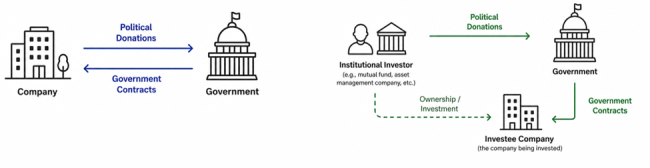
But most listed firms have little political machinery of their own. In our sample, the median firm spends nothing on lobbying or through a PAC. Its shareholders are a different story: the large institutions that own most of listed America lobby and give to campaigns. In a paper presented at the 7th Annual RCF-ECGI Corporate Finance and Governance Conference, we ask whether these investors act as intermediaries of political capital for their portfolio firms. The evidence suggests they do.
Measuring shareholders’ political capital
Federal procurement runs to hundreds of billions of dollars a year, and awards involve real discretion: suppliers must learn what an agency needs, clear eligibility rules, and earn officials’ trust.
We link federal procurement records for about 3,000 US-listed firms over 2008-2025 to 13F holdings and to those institutions’ PAC and lobbying records. Our measure, PoliticalSpending, credits each firm with a share of every owner’s political activity, in proportion to the firm’s weight in that owner’s portfolio.
Because lobbying reports name the agencies they target, exposure differs across agencies: a firm can be highly exposed at the Pentagon and barely at all at Health and Human Services. We control separately for the firm’s own lobbying, PAC spending, and ties to powerful members of Congress.
More politically active owners, more contract value
A one-standard-deviation increase in exposure goes with a 0.77 percentage point higher chance of winning a contract from a given agency, about 9% more contract value, and about 8% more value per contract. These estimates compare the same firm and agency over time, net of shocks common to firms in the same US state and year.
The obvious objection is selection: perhaps politically savvy investors simply buy firms that were going to win anyway. A placebo test first rules out a mechanical artifact: across 1,000 random reassignments of investors’ political spending, the actual ownership network beats every placebo. To address selection itself, we use S&P 500 index inclusion, which reshuffles a firm’s investor base for reasons largely unrelated to its contracting prospects. The instrumental-variable estimates point the same way; we read them as supportive rather than conclusive, since index inclusion can change a firm in other ways too.
Access matters most once the door is open
The pattern is revealing:
- Keeping the door open, not opening it. Exposure barely relates to winning a first contract. The gains go to firms already inside: renewals, larger follow-on awards and shorter gaps between contracts.
- Concentrated at the Pentagon. Value effects appear in Department of Defense contracts, where awards are large, technical, and repeated. That fits a recent ECGI working paper showing that Washington steers defense firms through dependence and relationships rather than ownership, exactly where a well-connected owner can help.
- Strongest among larger firms. The link with winning a contract from a given agency appears mainly among larger firms, which have the compliance staff and capacity to act on opportunities.
- Brokerage, not shared ideology. If owners and managers simply shared political views, the effect should be strongest where they are aligned. Instead, it is stronger where managers’ politics differ from their owners’, consistent with owners acting as intermediaries.
Ownership reaches the state
The governance literature, including work on shareholder engagement and activism, sees institutional investors working inside the firm: monitoring managers, voting, engaging privately and running campaigns to change what managers do. Our results point to another channel: investors supplying a resource, political access, that firms cannot easily build themselves.
Bertrand, Bombardini, Fisman, Trebbi and Yegen show that ownership links shape what portfolio firms give politically. We look at what firms get back. Part of a firm’s political capital sits outside it: a supplier’s prospects may depend on its shareholders’ political resources, not only its own lobbying, PAC giving and congressional ties.
Is this good or bad? It could be either. Investor networks may help capable suppliers find opportunities and clear compliance hurdles, or they may reflect capture, with connected firms receiving preferential treatment. Our data show which awards were made, not the losing bids, the conversations behind the awards, or how well the work was delivered, so we cannot yet tell these stories apart.
What we plan to explore next
First, whose political capital matters? 13F filers range from index-fund managers to banks and insurers with large PACs. Separating them would sharpen the S&P 500 evidence, since index inclusion mainly shifts passive ownership. Second, which channel carries the effect? Lobbying targets agencies, while PAC money flows to legislators, so separating them will show whether access runs through agencies or through Congress.
These open questions are why the topic matters. If institutional investors can broker access to politically allocated money, the consequences of concentrated ownership reach beyond corporate decisions and share prices, into how public money is spent.
Janet Yaru Yang is a PhD student in the Department of Accounting at Bocconi University.
Wanli Zhao is a Professor in the Department of Accounting at Bocconi University.
This blog is based on the paper “Benefits from Shareholders: Evidence from Public Contracting”, which received the Best Paper Award at the 7th Annual RCF-ECGI Corporate Finance and Governance Conference, held in collaboration with ECGI. Universidad CEU San Pablo hosted the conference in partnership with ECGI, with support from the British Academy of Management’s Corporate Governance Special Interest Group and the Institute for Humane Studies. Visit the event page to explore more conference-related blogs.
The ECGI does not, consistent with its constitutional purpose, have a view or opinion. If you wish to respond to this article, you can submit a blog article or 'letter to the editor' by clicking here.