The ECGI blog is kindly supported by
The Shareholder Proposal at a Crossroads
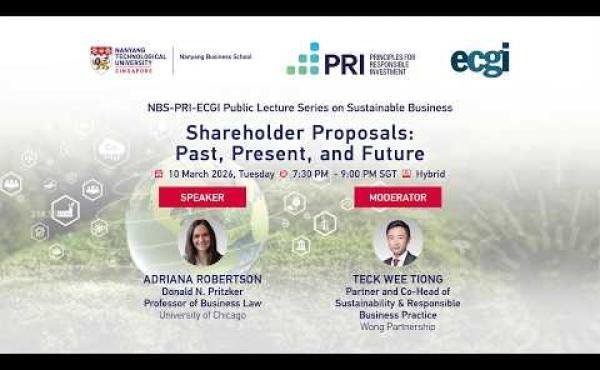
A review of the lecture “Shareholder Proposals: Past, Present, and Future” by Professor Adriana Robertson 10th March 2026.
Imagine filing a short document with a Fortune 100 company's board and compelling it to circulate your message to every shareholder in the country, respond publicly, and put the matter to a vote. A shareholder holding as little as $2,000 in stock — held for three years — can do exactly that. That is the logic and the power of the shareholder proposal, and it goes back to a rule created in 1942. In the latest NBS-PRI-ECGI Public Lecture, Professor Adriana Robertson offered a systematic account of how that mechanism has evolved, what it has become, and what may lie ahead.
An Inkblot Test for Corporate Governance
Robertson opened with a telling observation: shareholder proposals function as a kind of Rorschach test. ESG advocates see them as indispensable instruments of accountability, capable of shifting corporate behaviour on climate, diversity, and disclosure. Anti-ESG campaigners have, with considerable tactical ingenuity, turned the same tool against those positions, filing counter-proposals that challenge greenhouse gas targets or question the risks of viewpoint homogeneity on corporate boards. Sceptics view the whole enterprise as costly theatre. And regulators are actively considering a rewrite of the rules.
In their current form shareholder proposals simultaneously serve as a corporate governance mechanism, a market information and disclosure channel, and a public forum for political and social contestation — all three at the same time. That multiplicity explains why the tool looks so different depending on who is using it and what they hope to achieve.
Three Eras and a Fault Line
The shareholder proposal rule dates to 1942, and its early decades were largely preoccupied with classic governance concerns — board composition, executive pay, shareholder rights. The relatively few proposals that were filed tended to focus on classic governance issues. This began to change in the 1970s, when shareholders at Dow Chemical submitted a proposal seeking to prohibit the sale of napalm during the Vietnam War. Though a series of gradual developments, the SEC opened the door to proposals relating to significant social policy issues. That revision set the stage for what became the "disclosure and sustainability era" — roughly the mid-2010s through the early 2020s — in which proposals increasingly focused on environmental and social disclosure, often framed in the language of financial risk. Over time, growing resistance to these developments led to a backlash, which brings us to the current era of retrenchment.
The Vote Is the Tip of the Iceberg
A common misreading of how shareholder proposals work is to treat the vote as the main event. It is not. Between 35 and 40 per cent of proposals are withdrawn before ever reaching a ballot, typically because a settlement has been reached between the company and the proponent. Research by Robertson and co-author Jill Fish shows that companies disclose significantly more on the topics raised after both a vote and a withdrawal, with the effects remarkably similar across the two outcomes. Settlement is not a failure mode. For proponents, it is often the success mode. The vote is only the tip of the iceberg — and standard datasets that track only proposals that went to a vote miss a large and arguably more consequential part of the picture.
This also has implications for understanding who actually drives this process. While the rule permits tiny shareholders to act alone, in practice the space is dominated by repeat players and established networks. ESG-specialist asset managers, public pension funds, faith-based investor consortia, and nonprofit organisations all play significant roles. Even the so-called "gadfly" proponents, individual names that appear on a proxy statement, are typically deeply embedded in these larger networks, not spontaneous retail investors.
A Shifting Landscape
So far, the SEC has retained the shareholder proposal rule for material, company-relevant issues while reducing its availability as a generalised policy forum. Staff Legal Bulletin 14M rescinded 2021 policy changes, making it easier for companies to omit proposals not relating to core business issues. The SEC has also stepped back from its traditional role as referee of disputed exclusions, meaning disagreements are more likely to end up in the courts.
Institutional investors have pulled back in parallel. Both Vanguard and BlackRock are implementing pass-through voting, leaving decisions to end investors rather than their own stewardship teams. Perhaps the less noticed part of the story concerns red state pension funds: both the Florida SBA and the Teacher Retirement System of Texas were supporting environmental and social proposals at around 60 per cent as recently as 2021. That support has since collapsed to near zero, while support for traditional governance proposals has held firm. The 2025 proxy season reflected all of this: a decline in submissions, a spike in omissions, large drops in support for DEI and environmental proposals, and a high watermark for anti-ESG proposals.
The Toolkit Beyond the Rule
More regulatory changes are likely. Yet even supposing a full repeal of the shareholder proposal rule, corporate governance mechanisms would not disappear. Rather, they would evolve. Robertson's lecture mapped alternative mechanisms of shareholder engagement in roughly ascending order of intensity: direct engagement with management and letters to the board; voting on other matters such as director elections; escalation to proxy contests, which have become cheaper and more accessible since the introduction of the universal proxy; other legal remedies which may be available under state law; and ultimately divestment. The shareholder proposal rule is, and has always been, simply a bridge between federal securities law and state corporate law. The underlying governance rights exist independently of the bridge.
The Asian Contrast
The moderated discussion, led by Teck Wee Tiong, opened with a comparative perspective: in most Asian jurisdictions there is no equivalent of the US shareholder proposal. What exists are shareholder requisitions — binding votes requiring holdings of 5 to 10 per cent. The absence of a low-cost, precatory mechanism coupled with concentrated ownership structures, in which large institutions hold stakes in each other creating mutual deterrence, and more consensus-based business cultures, means that Asian jurisdictions do not see the levels of shareholder activity that the US does. Change is nonetheless visible: shareholders are increasingly banding together on governance matters, and the SGX is considering rules that would require companies to assist rather than obstruct requisitioners.
Questions from the floor surfaced the hardest issue: do proposals actually work? The empirical answer is genuinely uncertain. Companies are not targeted randomly, making causal identification difficult, and the existing academic literature points in different directions. On the outlook, Robertson was direct: even without further regulatory change, the current environment is not favourable for ESG-based proposals. Proxy advisors are stepping back, pass-through voting is fragmenting the institutional investor vote, and the direction of travel at the SEC is clear even if the destination is not. Whether the alternative governance tools — director elections, proxy contests, divestment — can fill the gap depends, in the end, on whether those using them are willing to put their money where their mouth is.
-----------------------------------
This lecture is part of the NBS-PRI-ECGI Public Lecture Series, a global initiative on sustainable business. Nanyang Business School (NBS), in collaboration with the Principles for Responsible Investment (PRI) and the European Corporate Governance Institute (ECGI), launched this series to foster knowledge exchange between academics, practitioners, and policymakers. As part of this initiative, leading academics present cutting-edge research on sustainability topics, while industry experts moderate discussions, providing real-world insights and facilitating dialogue between research and practice.