
The ECGI blog is kindly supported by

Liability Management's Limited Runway: Corporate Restructuring Today
Authors

Coercive, non-pro rata debt restructurings—now widely known as “liability management exercises” (LMEs)—have become a central tool for distressed borrowers over the past decade. Proponents argue the coercive LME typically buys a stressed company time to turn around and take off, avoiding bankruptcy and its costs.
In a new Article, we argue that this expectation is overstated. Our thesis is straightforward. Conceptually, the value-shifting nature of coercive LMEs need not produce stable, value-enhancing outcomes: the value shift from frozen-out creditors to participants can matter more to the participating dealmakers than fixing the firm. Their incentives are to take the value shift as long as the attributable firm losses are less than the value shifted. We then search empirically for actual outcomes following these coercive LMEs. The results, based on our hand-collected set of coercive LMEs, contradict the celebratory account: most LME debtors soon default again or file for bankruptcy anyway, and firm-level benefits seem modest overall, with multiple financial markers weakening or not improving.
An LME, broadly, is an out-of-court debt renegotiation—yesterday’s “workouts.” In recent years, the neutral LME label has displaced the blunter “creditor-on-creditor violence,” which once described debtors pitting creditor groups against one another and aligning with a winning coalition to elevate participants' priority (“uptiers”) or shift value away from the rest (“dropdowns”) in exchange for extended runway. The vocabulary changed; the tactics did not.
Some creditors lose in non-pro rata LMEs, others win; some lose in this deal and win in the next. But these are sophisticated, diversified investors, proponents argue, and coercion is needed to break the coordination and free-rider problems that would otherwise push firms into bankruptcy. In restructuring circles, well-known “success stories,” like Boardriders and AMC Entertainment, are celebrated: runway extended, bankruptcy avoided, operations revived.
Some deals do benefit firms and stakeholders. But is that the typical outcome?
Dealmakers can win by efficiently fixing the company. But they need not fix to win: if the value shifted away from frozen-out creditors is large enough, deals that fail to fix the firm still close—because dealmakers still profit. And a coercive LME’s structural imperatives push the firm's capital structure toward complexity, not deleveraging: to make an uptier work, majority creditors typically need higher-priority debt, not lower-priority equity—so balance-sheet stabilization suffers.
Ours is the first study to test coercive LMEs’ average firm-level effects, drawing on a hand-collected dataset of 89 deals—the most expansive assembled to date. The results are sobering.
Not even half of borrowers avoided bankruptcy or another default within a year of a coercive LME. Within two years, only 22% avoided both, while nearly 40% had already filed. Three years out, 71% had filed—and only 7% had avoided both bankruptcy and re-default.
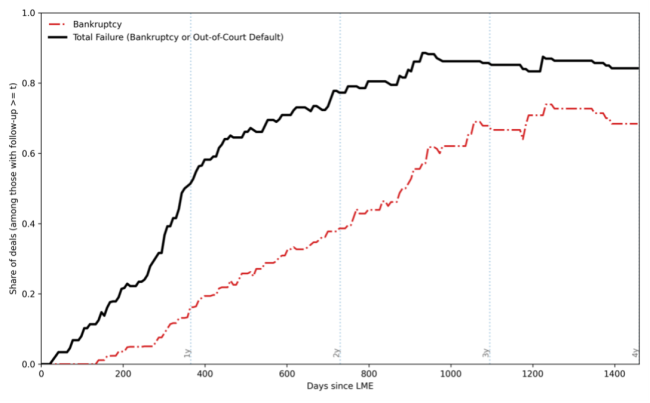
The figure above shows the coercive LME failure rising rapidly within a year of the deal and continuing to rise until, after three years, the overwhelming majority of coercive LMEs have defaulted or filed for bankruptcy. That LME relapse rate far exceeds our relapse estimates both for prepackaged bankruptcies, which require comparable creditor support, and for re-defaults among similar borrowers renegotiating through plain vanilla, pro rata exchanges—even with industry, year, rating, and size controls.
Nor do average firm-level benefits show up across-the-board after the coercive LME. Credit ratings stay largely flat for two years post-LME, with more than 88% of borrowers still rated CCC+ or below—signaling persistent fragility and high default risk.
Debtors sometimes secure new money that could help if spent well. But aggregate leverage does not decline; deleveraging in a coercive LME is much less than that of a typical prepackaged bankruptcy. Instead of stabilizing balance sheets through debt–equity swaps, LMEs elevate favored creditors—leaving thin equity cushions with distorted incentives, and a prolonged, pronounced debt overhang that makes a full turnaround harder.
Finally, LME debtors that go bankrupt spend, on average, two to three times longer in bankruptcy than non-LME prepacks and PE-backed debtors, as creditor infighting and litigation over the capital structure delay the reorganization itself.
Coercive LMEs may deliver little benefit to the company itself, but their costs are not negligible. Only a few elite law firms can handle them, and none is known to discount its fees for a coercive LME. Since most debtors default again or go bankrupt anyway, many pay twice.
These poor results match what our incentives analysis predicts: so long as value can be shifted from the frozen-out creditors, dealmakers gain whether or not the company is fixed—and value-destroying deals can go through more often than they otherwise would.
In short, non-pro rata LMEs generate less value for distressed firms—and more scope for rent-seeking—than commonly assumed. The report of their unstoppable rise in the restructuring space may be an exaggeration.
First, stronger covenants limiting coercive LMEs are emerging—ironically, beginning in post-LME debt, where creditors who benefited from one LME insist on blocking the next—and they sometimes migrate to the primary market. Cooperation agreements proliferate among vulnerable creditors. True, overall contract evolution is slow in ecosystems that prize standardization, but the anti-coercive moves are real, even if underappreciated.
Second, systemic tides in American finance may reverse—or reinforce—the conditions in which coercive LMEs flourished. After the financial crisis, low rates had creditors competing to lend, “strong” banks gave way to “weaker” dispersed creditor groups, and debt contracts grew vulnerable—weaknesses that “strong” private equity sponsors, behind roughly three-quarters of the deals in our sample, were well placed to exploit while delaying their wipeout in bankruptcy. But this “strong equity, weak(er) creditors” setup came from conditions outside the LME world and can change inside it if the outside world changes: if interest rates rise, if banks or private credit displace dispersed lending in high-risk segments, or if private equity’s funding plateaus, the balance may tip back toward “weak equity, strong creditors,” or even "strong equity, but also strong creditors," and thereby make coercive LMEs harder to accomplish.
Third, as the track record our Article documents becomes more widely recognized, future LMEs may meet a less welcoming legal reception than proponents assume. For one, even textualist courts interpreting ambiguous terms should not assume that LMEs are efficient escapes from distress, and therefore were bargained for from the start. Moreover, the evidence we present raises troubling fiduciary-duty questions. A coercive LME’s distortions can delay efficient recapitalization and capital reallocation, perpetuating debt overhang and overinvestment—ironically, the very disease that concentrated private-equity ownership was once prescribed to cure. For boards and their counsel, approving coercive deals that are as likely to fail as in our sample invites the question whether directors were adequately informed about the company’s best distress-resolution options, and whether the board was independent enough of its owners to earn judicial deference to its business judgment.
Overall, our evidence shows coercive LMEs to be structurally prone to fail. Success stories exist and are loudly celebrated, but they are uncommon. If courts, creditors, and contract drafters absorb this track record, the market practice of coercive LMEs may itself have a shorter runway than commonly thought.
______________
Mark J. Roe is the David Berg Professor of Law at Harvard Law School, and an ECGI Fellow and Research Member.
Vasile Rotaru is a Research Fellow at Harvard Law School.
______________
This blog is based on a paper presented at the 5th conference on The Law and Finance of Private Equity and Venture Capital, held at Goethe University Frankfurt. The conference was convened by Bocconi University, the DFG LawFin Center at Goethe University Frankfurt, LSE Law School, the Faculty of Law of the University of Oxford, and the Institute for Law & Economics at the University of Pennsylvania, together with ECGI., Visit the event page to explore more conference-related blogs.
The ECGI does not, consistent with its constitutional purpose, have a view or opinion. If you wish to respond to this article, you can submit a blog article or 'letter to the editor' by clicking here.