
The ECGI blog is kindly supported by

How Shareholder Voice Shapes Board Agendas
Authors


Corporate governance often focuses on formal votes for evidence of influence: for example, when a director dissents or shareholders reject a proposal. Yet much of the influence may arise earlier in the decision process, when insiders and directors who monitor them negotiate which proposals reach the board agenda in the first place. If a contentious proposal never reaches the agenda, the formal record may show unanimity, even though governance has worked.
In our presentation at the 2026 Global Corporate Governance Colloquium, we study this earlier stage of the decision process. We connect more than 1.2 million board proposals and 10.8 million individual director votes with 780,000 shareholder-meeting proposals at Chinese listed firms from 2005 to 2018. These data allow us to trace proposals through the full decision process: from the board agenda to director voting and, when shareholder approval is required, to voting at the shareholder meeting.
A small board position can represent a large shareholder meeting threat
Chinese listed firms provide a useful setting because ownership is concentrated and larger minority blockholders often appoint directors under cumulative voting. These minority-blockholder-affiliated directors (MBDs) occupy only 0.67 seats on an average nine-member board, so they usually lack the voting power to block a board proposal on their own. However, their influence can come from the shareholders who support them. A blockholder who helped appoint a director can hold a meaningful equity stake and can oppose a contentious proposal if it reaches the shareholder meeting stage.
This threat is especially relevant for related-party transactions, which can represent tunneling activity. In China, conflicted controlling shareholders are required to recuse themselves from voting on these transactions at the shareholder meeting. This gives minority shareholders greater voting power over these transactions and can strengthen the bargaining position of the directors they appoint at the earlier board stage. Yet formal board dissent is rare: only 0.56% of board proposals receive any dissent. That makes the board agenda-setting stage a natural place to look for blockholder influence that voting records miss.
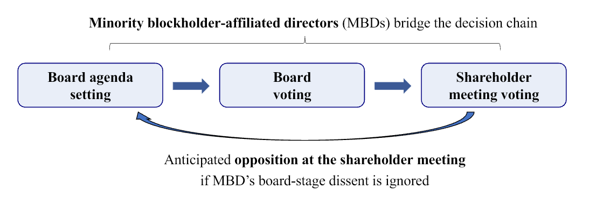
The figure below illustrates this mechanism. Shareholder voting power feeds back into board agenda-setting. An MBD backed by shareholders who can credibly oppose proposals at the shareholder meeting can bargain over a proposal before the formal board vote. As a result, contentious proposals are often revised or kept off the board agenda altogether.
A reform making shareholder dissent more visible changes board agendas
We exploit a 2014 disclosure reform that increased the visibility of minority-shareholder dissent at Shenzhen-listed firms. After the reform, Shenzhen firms were required to separately disclose the number of attending shareholders holding less than 5% of the firm’s shares. They were also required to disclose the dissent rates of these “below-5%” shareholders next to each proposal. Both changes made minority-shareholder opposition more salient. The number of dissenting small shareholders matters because the same dissent rate looks more consequential when it comes from hundreds of investors rather than a handful. Placing minority-shareholder voting results alongside each proposal makes it clearer which proposals attracted shareholder opposition. The reform did not give MBDs more board seats or change shareholder voting rights. It simply made future shareholder opposition more visible and potentially more costly. By contrast, Shanghai firms did not provide the same proposal-level dissent visibility.
Our empirical design compares Shenzhen-listed with Shanghai-listed firms before and after the reform and exploits the 5% disclosure threshold by focusing on blockholders with shareholdings just below versus just above it. Shenzhen firms with MBDs backed by shareholders just below the 5% threshold are the group most directly affected by the new disclosure rule.
The effect on board agendas is substantial. We find that boards with these newly strengthened minority shareholders become much less likely to place tunneling proposals on their agendas. For a nine-member board, one affected MBD seat reduces the probability of a tunneling proposal appearing on the agenda by about 25% relative to the sample mean. We find no comparable change for MBDs backed by shareholders just above the threshold.
MBD dissent can trigger shareholder opposition across proposals
Following the Shenzhen shock, the decline is larger for related-party transactions that require shareholder approval, consistent with a direct shareholder voting threat. But the decline is also observed for board-only related-party transactions that shareholders never vote on. This points to a broader bargaining channel: a minority blockholder can oppose other important proposals at a future shareholder meeting, giving insiders incentives to compromise on board-only transactions.
We find further evidence for this mechanism following MBD dissent at the board meeting. When a large MBD publicly dissents on a related-party transaction requiring shareholder approval, shareholder attendance at the subsequent shareholder meeting increases, shareholder support for the proposal falls by 19 percentage points, and the proposal is more likely to be withdrawn or revised. Opposition also spills over to other proposals at the same meeting, suggesting that the effect is not confined to the disputed transaction. Even when the disputed transaction requires only board approval, leaving shareholders with no approval rights, support for other corporate proposals at the next shareholder meeting declines. Together, these results show that the threat of shareholder opposition is both observable and costly.
Low dissent may signal effective governance
The above evidence should change how researchers interpret board and shareholder meetings with little recorded dissent. In our sample, formal board dissent is extremely rare. Shareholder meetings show a similar pattern: proposals receive average support of 98.8%, and only 0.57% are rejected. Those numbers can suggest shareholder and director passivity. However, they can alternatively reflect earlier agenda filtering: proposals most likely to trigger conflict have already been revised or withdrawn before reaching a vote. Formal votes therefore capture the proposals that survive this agenda-filtering process and miss conflicts resolved earlier through active internal governance.
The agenda-setting mechanism is not unique to China. Closely controlled firms, family firms, dual-class firms, business groups, and companies with activist-appointed directors can all involve shareholders with limited board representation who can dissent at subsequent shareholder meetings. In these settings, simply counting board seats or dissenting votes can understate these directors’ influence over board decisions. The same logic applies to reforms that strengthen shareholder voice at the shareholder meeting stage. Such reforms can improve governance by changing board agendas, so that even if proposal rejection rates remain flat or even fall, fewer problematic proposals actually reach shareholders.
More broadly, our results suggest that governance operates through a decision chain. To understand how boards and shareholders shape corporate decisions, we must ask which proposals reach the board agenda, how board disagreement affects subsequent shareholder action, and which conflicts disappear before anyone is asked to vote.
Nadya Malenko is a Professor of Finance and Wargo Family Faculty Fellow at Boston College, Carroll School of Management, Seidner Department of Finance, and an ECGI Research Member.
Ronald W. Masulis is Scientia Professor in Finance at the Australian School of Business, University of New South Wales, and an ECGI Research Member.
Qi Wang is a Postdoctoral Fellow in Applied Economics at CUHK-Shenzhen.
This blog is based on a paper presented at the the twelfth annual Global Corporate Governance Colloquia (GCGC), hosted by the National University of Singapore and ECGI. Visit the event page to explore more conference-related blogs.
The ECGI does not, consistent with its constitutional purpose, have a view or opinion. If you wish to respond to this article, you can submit a blog article or 'letter to the editor' by clicking here.