Who Controls the Defence Industry?
Working Paper Author/Authors

Key Finding
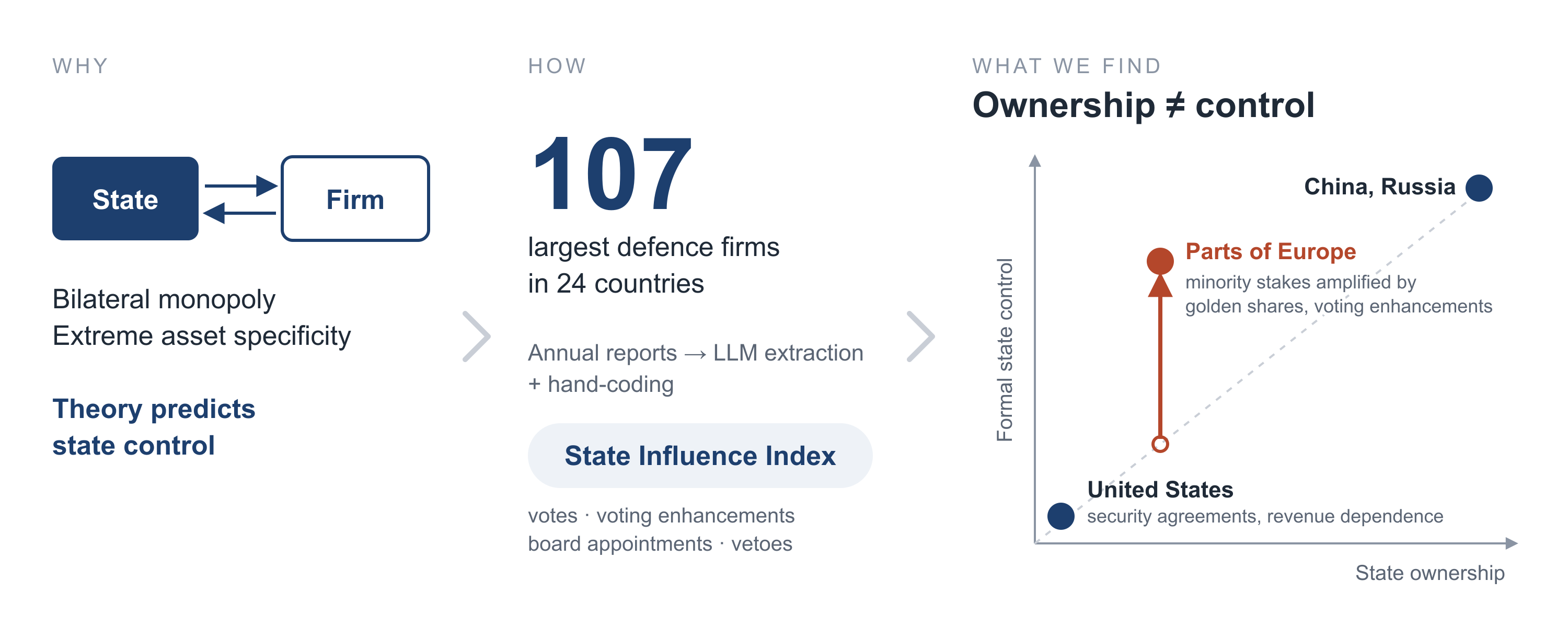
States control defence firms through legal and governance mechanisms well beyond what their equity stakes alone would predict
Abstract
Defence markets exhibit extreme asset specificity and bilateral monopoly. Transaction-cost economics predicts state ownership or control in such circumstances. This paper examines what governments actually do. Ownership alone does not determine control. A state with zero equity can still have influence through governance provisions and legal tools. Using large language model extraction from annual reports, supplemented by hand-coding, we compile a leximetric dataset on corporate governance and state control for 107 of the world’s largest defence companies, drawn from the SIPRI Top 100 for 2022–2024, in 24 countries. We construct a novel State Influence Index (SII) aggregating voting power, voting enhancements, board appointment and veto rights. State ownership is bimodal: full state ownership at one end, no state ownership at the other. Formal control varies independently. China and Russia combine full ownership with full control. The United States has no ownership and little formal control, relying instead on security agreements, revenue dependence and personnel interchange. The rest of the distribution is dispersed. Some countries combine minority equity with legal devices that amplify formal control well beyond ownership stakes. Others rely on regulatory mechanisms with little or no formal governance authority. In several cases, states have delegated control to domestic families operating under implicit state leverage. A complementary State Restraint Index shows that European companies with high state influence tend also to score higher on voluntary self-limitation, consistent with credible commitment to attract private capital. Cross-border cooperation is producing new governance architectures that partition operations across national subsidiaries to reconcile economies of scale with sovereign control. Corporate governance mechanisms matter most when defence entities operate beyond the home state’s jurisdiction, where regulatory authority alone does not reach. The patterns are consistent with transaction-cost and property-rights reasoning about asset specificity and bilateral dependence, although the institutional form of state control varies with legal tradition and political economy.
© Marco Becht, Juan Mejino-López, Guntram B. Wolf, 2026
All rights reserved. Distributed for discussion purposes only; not to be reproduced without permission.
The views expressed are those of the author(s) and do not necessarily reflect those of ECGI or its members.
For copyright queries or takedown requests, contact wp@ecgi.org.