The ECGI blog is kindly supported by

Putting a Dollar Number on the Risk Factors
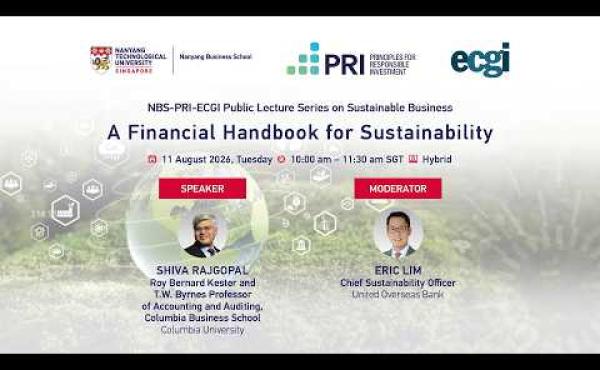
A review of the lecture “A Financial Handbook for Sustainability” by Professor Shivaram Rajgopal 11th August 2026.
A very large sovereign wealth fund says it takes sustainability seriously. Asked what that means in practice, it says it collects KPIs, religiously. Asked what it does with them, the conversation stops. The same silence runs through the chain: the standard setters behind the ISSB's S1 and S2 cannot explain how a reader gets from disclosure to risk assessment, and the CFOs publishing KPIs want to know what analysts do with them.
That opened the thirteenth NBS-PRI-ECGI lecture, given by Shivaram Rajgopal, Roy Bernard Kester and T.W. Byrnes Professor of Accounting and Auditing at Columbia Business School, and moderated by Eric Lim, Chief Sustainability Officer at United Overseas Bank.
Part of the silence is political, with one side pushing environmental policy through investment, a channel never built to carry it, and the other insisting business has taken work belonging to politicians. Hence the ambition behind Making Sustainability Financially Relevant, written with Bob Eccles: make sustainability boring again, so it loses its enemies and survives.
From risk factors to cash flows
Roughly 30 to 40 per cent of the risk factors in a typical 10-K are environmental or social in substance. G almost never appears, because no company confesses to weak governance; SpaceX goes no further than key man risk around Elon Musk. The SEC chair would scrap them as useless, yet boards read thirty pages and still cannot say what it all costs.
The proposed solution mechanics are deliberately unglamorous. Mark each risk factor as E, S or G using the SASB industry map, which he conceded is out of date. Link each to income statement and balance sheet lines, pull the KPIs companies already report, simulate cash flow impacts under high, base and low scenarios, rank the top risks by distribution, and write it up as a memo a CFO or portfolio manager can use. The estimates are openly imprecise, which Prof Rajgopal, treats as the point: once the argument moves onto parameters, people fight about numbers instead of politics.
What the testing shows
ExxonMobil served as the worked example, and by hand it cost over a hundred hours, which is why boutique methods never survived an indexed world. Emissions show how far past the familiar number the analysis then travels. Exxon's Scope 3 dwarfs Scopes 1 and 2, and counting it at all is disputed, since oil and gas companies call those emissions the customer's. Include it, apply a carbon price of $39 a ton, and about $25 billion of social cost appears. But a cost that can be passed on is a different animal, which turns everything into elasticity of demand: low in the short run, since we all keep consuming oil whatever the price, and rising over ten to fifteen years. Stranded assets, a favourite NGO theme, dissolve on inspection, since a barrel costs $30 to $35 to acquire and a twelve-year reserve life leaves little in the ground. Aramco, on fifty years of reserves, is another matter. On financial materiality alone, E and S are not a large problem for Exxon in the short run. Prior revised.
Applied to SpaceX, the method surfaced FAA delay on Starlink authorisations as a bigger cash flow risk than the founder control behind MSCI's CCC rating.
The view from the other side
Eric Lim reframed a decade of reporting as four phases: the do-good era; the ESG era, when everything under the sun found its way into 600-page reports; the commercial-language phase, which built a lexicon only sustainability professionals understand; and now the so-what stage. UOB's most important disclosure is financed emissions, the Scope 3 of its lending book. Three or four years ago investors called about it. Today they do not.
- Where is the biggest misunderstanding between standard setters and the reporters asked to produce the disclosures?
Political economy. Very few standard setters are investors, so lobbies and companies angling to look good shape the process. The largest shareholder of major American companies is a computer program, and passive giants care little what a 10-K says. What is left is a supply of information for which there is no demand.
- So how is a company supposed to internalise an externality with no mechanism to do it?
It won't. The textbook answer is a tax or a regulation, both bad words in the US, which left the job to companies by default. Push it further and a bank looks like a trucking company: whether you haul oil, guns, tobacco or bananas, does the hauler own the cargo's morality?
What surfaced in both cases was rarely the E anyone expects, and much more about whether employees are happy and the reputation holds. UOB no longer finances coal-fired power plants, and nobody got there by calculating carbon tax against credit risk. The reputational damage was simply not worth it. The E became reputational risk, and reputational risk became strategy, a policy decision needing transparency and no pricing at all.
Then the distinction that framed the rest: acute risk kills quickly and violently, chronic risk kills slowly. Everyone can picture the data centre underwater and knows that playbook. The slow burn is harder, and Singapore's roads make the case, remade in five or six years by Chinese EVs, leaving the internal combustion ecosystem under chronic transition risk.
- How would that industry go through the methodology, and what would it produce?
It is all scenario planning, a matter of horizon, and anything scenario-plannable the methodology will handle, which here means modelling the rate of substitution. That rests on trade policy, which is why there are no BYDs in the US and why the US government is the biggest counterparty risk American business faces. Some of it is close to unplannable, and isn't that entrepreneurship: BYD's bet paid off when policy turned its way, while Toyota's hybrid hedge may or may not.
- What should AI users who are not engineers watch out for?
Around November 2025 both Claude and GPT hit an inflection point, and what had been very hard at scale became easy. AI is 90 per cent fantastic, though the last 10 per cent needs a human who knows the domain, and that expertise gets harder to build as the apprenticeship work disappears. You will always need a human brain in a box to imagine the scenarios the machine then runs.
-----------------------------------
This lecture is part of the NBS-PRI-ECGI Public Lecture Series, a global initiative on sustainable business. Nanyang Business School (NBS), in collaboration with the Principles for Responsible Investment (PRI) and the European Corporate Governance Institute (ECGI), launched this series to foster knowledge exchange between academics, practitioners, and policymakers. As part of this initiative, leading academics present cutting-edge research on sustainability topics, while industry experts moderate discussions, providing real-world insights and facilitating dialogue between research and practice.