
The ECGI blog is kindly supported by

Index Ownership Has Gone Global
Authors


Twenty years ago, the share register of a large European company was made up of families, banks, the state, insurers and active fund managers, who liked the shares for any number of reasons. Today a substantial and growing part of it belongs to investors who own shares because the company is in an index.
Index ownership has several well understood effects. Index investing is very cheap and has provided diversified equity exposure at a fraction of what it used to cost. Index funds tend to hold large pools of assets for a long time. This makes index funds stable, long-horizon owners, and they tend to vote for independent directors and against takeover defenses. They are also owners who did not choose the company, hold thousands of investment positions in other companies, can give none of them much attention, and trade mechanically, which affects price formation.
The substantial and high-quality research on these topics is almost exclusively American. How important is index-driven ownership outside the U.S.? In our recent study, we address this by using portfolio data and fund descriptions to classify shareholders globally as index-based or not. Our method does not need third party classifications (often absent outside the U.S.), and uses data that is broadly available for public companies around the world. Our method also separates explicit indexing — funds that say in their name or description that they track an index — from closet indexing, portfolios that behave like index funds without saying so. In the U.S., essentially all growth since 2010 has been explicit indexing. In Europe the two are similar in size, and explicit indexing has only recently pulled ahead.
Our quantitative model essentially asks whether a fund behaves like an indexer: little trading, many positions, near-proportional stakes across holdings, and position changes that move in parallel rather than name by name. Four such characteristics plus a fund-description indicator reproduce Morningstar's index classification for 98% of assets under management, and work on any fund anywhere that reports holdings. The result is a quarterly panel of index ownership for 78,000 companies, 2004 to 2023.
We find that index-based investors owned 3% of world market capitalization in early 2004 and 17% at the end of 2023. In 2004, 232 public companies worldwide had index ownership above 10%, and just 19 of them were outside the United States. By 2013 there were 2,416 companies, a fifth of them non-U.S. At the end of 2023 roughly 5,300 companies had index-based investors holding 10% or more of their shares — and half of those companies were outside the U.S.
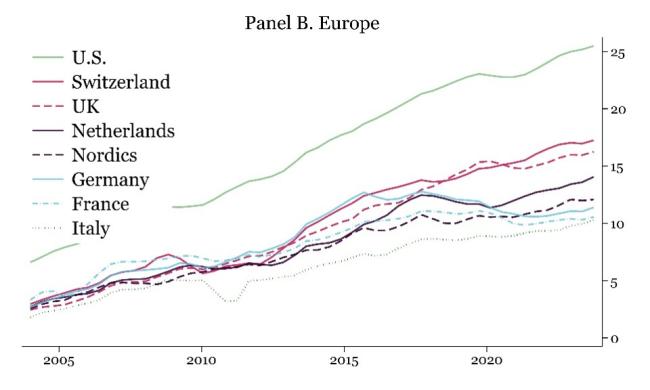
There are important cross-country differences in the growth of indexing: Switzerland and the UK are in excess of 15% in index ownership, and all large markets in Europe are over 10% (see figure). Japanese companies have the second-highest index ownership in the world, and South Korea, India and other Asian markets are also seeing growth (China less so).
Across firms, patterns differ substantially between the U.S. and other markets. In the United States, index ownership is hump-shaped in size: it climbs steeply once a company is worth a few hundred million euros, peaks near 30% in the low billions, then falls, so the largest U.S. firms have less index ownership than mid-caps. That is the footprint of index families that reach a long way down — the Russell 3000, the S&P MidCap 400, the S&P SmallCap 600.
Outside the U.S. the relationship is monotonic. Small caps have almost no index-based ownership. European mid-caps have roughly a quarter of what comparable U.S. firms have, and only at the very top does Europe reach about half the U.S. level. This may reflect local indexes: the DAX has forty constituents, the CAC 40 forty, MSCI Europe around four hundred.
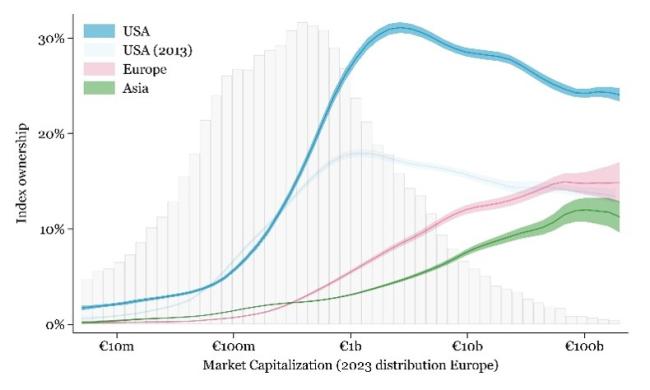
Given these cross-sectional differences, the consequences of indexing are affecting European and Asian firms unevenly. Passive ownership is concentrated in the largest few hundred companies. This is where price formation, market efficiency, and corporate governance impact is likely to be noticed first.
Bo Becker is the Cevian Capital Professor of Finance in the Department of Finance at the Stockholm School of Economics, Research Fellow of Center for Economic Policy Research (CEPR), and an ECGI Research Member.
Rüdiger Fahlenbrach is Full Professor of Finance Swiss Finance Institute, Research Fellow of Center for Economic Policy Research (CEPR), and an ECGI Research Member.
Ehsan Mahdikhani is a Ph.D. candidate in the Finance Department at the Stockholm School of Economics and the Swedish House of Finance.
This blog is based on a paper presented at the the twelfth annual Global Corporate Governance Colloquia (GCGC), hosted by the National University of Singapore and ECGI. Visit the event page to explore more conference-related blogs.
The ECGI does not, consistent with its constitutional purpose, have a view or opinion. If you wish to respond to this article, you can submit a blog article or 'letter to the editor' by clicking here.