The ECGI blog is kindly supported by

How Environmental Entrepreneurship Can Bridge the Climate Action Gap
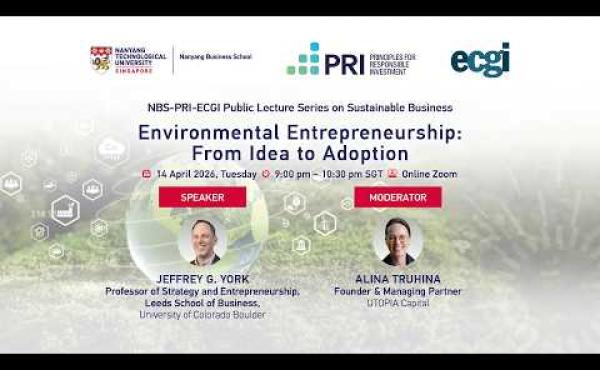
A review of the lecture “Environmental Entrepreneurship: From Idea to Adoption” by Professor Jeffrey G. York14th April 2026.
Climate change is not a technology problem. The science is unambiguous: to keep global warming below 2°C, humanity can afford to burn roughly 565 gigatons of carbon by 2100. Known reserves stand at 3,500 gigatons — seven times that figure. The gap is vast. More innovation is still needed, but the real constraints lie elsewhere—in economic, social, and institutional systems.
That is the territory Prof. Jeffrey York has spent two decades mapping. His latest lecture in the NBS–PRI–ECGI series offered a research-grounded framework for environmental entrepreneurship operating across three levels: the individual, the organisation, and the industry.
It starts with the self
Environmental entrepreneurship, in this framing, is not a niche for clean-tech founders. It is a broader idea: the simultaneous creation of economic and ecological value. That could mean a startup, but equally a new policy, a new market, or action taken inside an existing firm.
What matters is not only what opportunities exist, but who can see them. Entrepreneurship is treated not as a personality type but as something filtered through identity. A person carries multiple roles at once — professional, familial, ecological, civic — and those roles shape both perception and action. Someone driven purely by profit spots one type of opportunity. Someone driven purely by environmental conviction spots another, but may struggle to act beyond a narrow circle. The more consequential figure is the one who holds both worlds together: a hybrid identity where professional skill, ecological concern, and ordinary life responsibilities converge.
Throughout the lecture, Alina Truhina, an investor with experience across Africa, Southeast Asia, and the Middle East, brought the framework into contact with the questions from practice. She noted that in many contexts, family expectations still define what a successful career looks like — and launching a climate venture rarely fits that picture. The wider culture of risk compounds this: where societies do not celebrate experimentation, seeing opportunity becomes harder in the first place. Yet people often become trapped in one role and mistake it for the whole self — and recognising that other identities can be cultivated is precisely what creates the capacity to act. It is also why accelerators matter beyond funding. The most important benefit identified by climate-tech founders is community — being placed among others who do not treat environmental ambition as naive or commercially irrelevant. Collective recognition makes risk more manageable.
Then the self meets the institution
Once the frame moves outward, the problem changes. Individuals may carry agency, but climate action requires organisations — and that is where friction begins.
The Boulder Energy Challenge — later studied by Embry and York as a case of entrepreneurial public-private partnerships — illustrated what happens when public and private actors attempt to work together on uncertain solutions. The city had funds dedicated to climate action and the ambition to stimulate market innovation. A steering committee brought together people from entrepreneurship, investment, engineering, and consulting alongside public officials. Almost immediately, two institutional logics collided.
City government approached the task through risk control, procurement logic, and anxiety about public money. The steering committee approached it as a problem of experimentation and long-term scaling. One side wanted to know how funds would be monitored; the other wanted to know whether anything lasting would emerge at all.
The result, at first, was frustration. Startups were delayed for months because the city had no ready mechanism for funding firms whose product was still taking shape. Public officials worried about accountability; entrepreneurs felt trapped in meetings instead of building.
Yet the story did not end there. Over time, the city came to see that its real contribution was not only funding, but legitimacy: access to customers, contacts, and local networks that entrepreneurs would not otherwise reach. Entrepreneurs began to recognise that what felt like bureaucratic drag could also be a route into markets. Conflict became usable.
Truhina pushed on the most delicate point in this sequence: many ventures fail not because nobody cares, but because the gap between public and private incentives never closes. What mattered in Boulder was early exposure — public actors spent sustained time with people who thought entrepreneurially before formal partnerships were locked in. Diverse steering committees, repeated conversations, and a clearly shared concern — climate change itself — made it possible to disagree without walking away.
Finally, the organisation becomes an industry story
As environmental entrepreneurship moves beyond individual organisations, it begins to take hold at the level of industry and policy. This is illustrated by the development of wind energy in Colorado, where government, industry, and entrepreneurial entry gradually come to reinforce one another.
The early phase was a familiar deadlock: environmental groups insisted on the costs of fossil fuels; utilities answered with the standard case for coal. What changed the trajectory was not ideological conversion but compromise. Western Resource Advocates, after years of conflict with the local utility, worked with it on a pilot allowing customers to opt into wind power. The compromise began as an experiment.
The political language around it is telling. The first public framing still revolved around cost: wind would protect the environment, but it "doesn't come cheap." Only later, as prices shifted and entrepreneurial entrants proved that wind could be commercially viable, did the argument itself change. Clean energy ceased to be framed as an environmental sacrifice and started to be framed as a win-win. That reframing created room for new organisations to emerge — groups that advocated for renewables not only because they were cleaner, but because they were economically productive and scalable. The old opposition between ecology and economy began to weaken.
The sequence, not the slogan
This is the larger claim. Climate action at scale does not come from regulating existing firms a little more tightly, nor from asking consumers to behave better. It comes when activism, entrepreneurial entry, and policy start reinforcing one another: activism creates pressure, entrepreneurship makes alternatives real, policy embeds them.
The discussion raised a concern wether any of this translates to regions with very different regulatory systems, cultures, and incentives — Africa, Southeast Asia, parts of Europe. No universal template emerged, but the pattern held: entrepreneurial interventions appear to work in both pro-market and pro-environment settings, suggesting they may offer one route through otherwise entrenched political divides.
What remains is not a slogan but a sequence. Climate action begins with the self, but cannot stay there. It must move through organisations, into coalitions, and finally into industries and policy. The decisive obstacle is more human than technical: whether people, institutions, and markets can learn to act together before the window narrows further.
-----------------------------------
This lecture is part of the NBS-PRI-ECGI Public Lecture Series, a global initiative on sustainable business. Nanyang Business School (NBS), in collaboration with the Principles for Responsible Investment (PRI) and the European Corporate Governance Institute (ECGI), launched this series to foster knowledge exchange between academics, practitioners, and policymakers. As part of this initiative, leading academics present cutting-edge research on sustainability topics, while industry experts moderate discussions, providing real-world insights and facilitating dialogue between research and practice.