The ECGI blog is kindly supported by

Stop stereotyping directors!
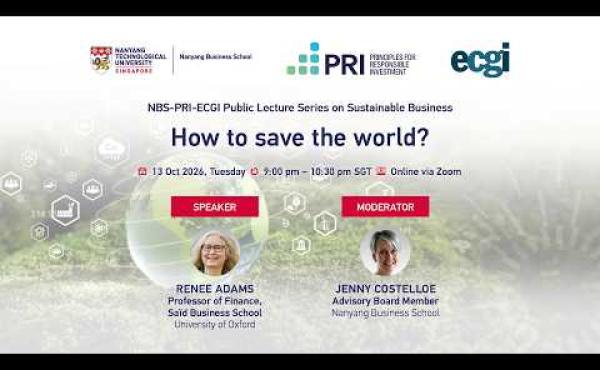
A review of the lecture “How to Save the World” by Professor Renée Adams, 13 October 2026.
“How to save the world” is an ambitious title for a single lecture, and Renée Adams, Professor of Finance at Saïd Business School, University of Oxford, and ECGI Research Fellow, stated that it was deliberately provocative. The discussion that followed was moderated by Jenny Costelloe, Advisory Board Member at Nanyang Business School.
Responses to global crises tend to take one of two routes. The first relies on processes: regulation and legislation on ESG, CSR and corporate purpose. The second relies on people: typically, by placing different people in positions of influence.
The boardroom under scrutiny
Both routes converge on the boardroom. The European Union’s Sustainable Corporate Governance Initiative sought to regulate directors on the argument that they are a key obstacle to sustainability, assuming that they favour short-term shareholder value over stakeholder interests.
The alternative is to change who sits on boards. Catalyst has argued that more women leaders means more corporate social responsibility, assuming that caring about stakeholders is caring about “others” and that women are more “other-regarding” than men. Similarly, many assume the next generation might be less self-involved and more caring. Claims also circulate that traditional family values hold the key to a better future. Since family firms are seen as resilient and long-term, such values might also support sustainability. Encouraging family values also ensures there is a next generation.
Renée examined these narratives using an evidence-based approach informed by ideas and data from her co-authored papers. The analysis compiles data on Schwartz human values for the general population, Oxford MBA students (a stand-in for the next generation), directors, and finance academics. The Schwartz value framework includes the value of “universalism”, a measure of self-transcendence that covers tolerance, social justice, equality and protecting the environment.
For directors and Oxford MBA students, the research also measures “shareholderism”: how much a person acting as a director favors shareholders over stakeholders. The data come from surveys that were carefully designed to elicit individual preferences in situations of conflict between shareholders and stakeholders.
Using data from the general population, directors and Oxford MBA students, Renée showed that at first, the data seem to support conventional narratives. In a regression of universalism, directors score lower than others, while women, students and pro-family members of the population score higher. If being other-regarding is sufficient to solve sustainability crises, the solution seems obvious: put women and the young in charge, celebrate the family, and leave existing directors behind.
Questioning the narratives
Yet there are many reasons to question the conventional narratives. Generalizations are a concern, as demographic and occupational characteristics may not be sufficient statistics for preferences. Moreover, individuals are bundles of attributes, but the literature often treats them as one-dimensional. There is also a tension: on the one hand women are supposed to take charge. On the other, they are supposed to stay at home and have children. Questioning the family values narrative is especially important if it could lead to backsliding on women’s rights.
Renée then took a closer look at her shareholderism measure. A histogram of this measure revealed that most of the mass of directors fall in the middle of the distribution between completely pro-stakeholder (a value of 1) and completely pro-shareholder (a value of 6).
Even in the US, seen as very pro-shareholder, the picture is the same. Thus, the legal regime is not correlated with director attitudes. This casts doubt on the ability of processes to dictate how directors think.
While the data cast doubt on the idea that directors are too pro-shareholder, Renée highlighted that it is unclear what the right level of shareholderism is. Oxford MBA students offer an interesting benchmark for directors as they represent the next generation. Plus, Oxford’s MBA program is known for being pro-social. However, the distribution of shareholderism for Oxford MBA students is remarkably similar to that for directors, and there is no statistically significant difference between students and directors.
Renée then showed that on average, female directors are more pro-shareholder than male directors. For those who measure merit by shareholder orientation, the data run against the claim that diversity works against it.
The missing piece is selection
Why do the data on shareholderism not line up with conventional narratives? Renée argued that there is a missing understanding of selection in the debate. To become a director, a person must choose a career leading to a board seat and must be chosen for the seat. Because it is hard to become a director, especially for women, directors are atypical. The problem with conventional narratives is that they are informed by population data, i.e. “typical” people, not data for directors.
Benchmarking data on directors to the population illustrates the consequence of selection. Directors are generally less universalist than individuals in the general population. But female directors are more atypical as opposed to their population counterparts than male directors are. As a result, the population gender gap she showed at the beginning of the lecture, that women are more universalist than men, flips in the boardroom. Similarly, the population gender gap for another Schwartz value, that of power, flips in the boardroom. In the boardroom, women are more power-oriented than men.
Universalism is associated with being pro-stakeholder, but power is associated with being pro-shareholder, so the greater pro-shareholder orientation of female directors is no longer a puzzle.
Context shapes selection too. Female directors are more pro-shareholder than men in Australia, Italy and the UK, and more pro-stakeholder in Spain, Ireland and India. Generally female directors are more pro-shareholder in countries that score high on a cultural measure of masculinity. These are more tradition-oriented societies, where it would be harder for women to reach the board. As Renée put it in the discussion, preferences are less about gender and more about how people build careers and are chosen for them.
Gender quotas do not weaken this argument. Quotas bring more women onto boards, but this does not mean female directors are necessarily more pro-stakeholder than men when there is a quota. Appointing women to boards may bring more stakeholder orientation if they are Oxford MBA students, but this reinforces the point that preferences are less about gender and more about career. This argument does not call the use of quotas per se into question, but it does challenge the expectation that a quota can deliver a particular attitude in the boardroom.
Should women stay home?
If women cannot reliably deliver expected leadership attributes, should they stay home? Initially Renée showed that pro-family individuals in the population are more universalist, which seems a positive for sustainability. But there are reasons to be concerned that “traditional” family values could lead to backsliding on women’s rights. Pro-family individuals are more likely to believe three things: that men should not take as much responsibility as women for home and children, that women should cut back on paid work for the sake of the family, and that men have more right to a job when jobs are scarce.
The Schwartz value profile of pro-family individuals is also more conservation-oriented, raising the question of whether this is the value profile that would help us out of global crises. A comparison of the values of pro-family individuals to those of directors in family firms is telling. Family firm directors in Sweden and Turkey do not exhibit these “traditional family” values. They are more power-oriented and self-directed, and much less tradition-oriented. Female family firm directors are less conformist and less security-oriented than their male colleagues.
The data therefore cast doubt on the benefits of “traditional family values”. Such values are not reflected in family businesses, which are considered important for growth and sustainability. Moreover, asking women in family businesses to stay at home could lead to less diversity of thought and a reduction in values that are important for innovation.
Humility over easy answers
The lecture posed a series of questions. Do processes always work? Can findings from the population be applied to the boardroom? Must women stay at home to save the world? Each time, the answer was no. “The point is there are no easy answers.” Processes may help, but they need to be informed. Women should be present everywhere, but not to fulfil simplistic assumptions about what they will deliver. The way forward is to question assumptions, with evidence and humility. The central open question is selection itself: how do we ensure the right people are in charge?
Is there hope?
The lecture closed on a note of optimism. Renée highlighted that her MBA students appreciated when she challenged their assumptions using their own data and expressed a desire for more challenging material. This suggests that the next generation has the capacity for the type of critical thinking that is needed to change the world. The burden is on us to produce the material that can educate them. Renée ended by showing data on finance academics, who are more universalist than members of the general population. The difference is not large, but it stands in stark contrast to the difference for directors, who are less universalist than members of the general population, regardless of gender.
Renée argued this data call current pushback against academics into question as they illustrate that academics have the incentives to work for the benefit of society. She expressed hope that this evidence-based approach shows the value that research and evidence can bring to addressing global crises.
-----------------------------------
This lecture is part of the NBS-PRI-ECGI Public Lecture Series, a global initiative on sustainable business. Nanyang Business School (NBS), in collaboration with the Principles for Responsible Investment (PRI) and the European Corporate Governance Institute (ECGI), launched this series to foster knowledge exchange between academics, practitioners, and policymakers. As part of this initiative, leading academics present cutting-edge research on sustainability topics, while industry experts moderate discussions, providing real-world insights and facilitating dialogue between research and practice.