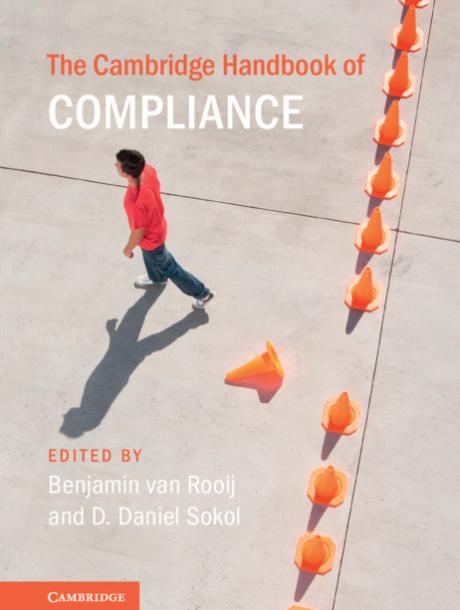
The Cambridge Handbook of Compliance
Compliance has become key to our contemporary markets, societies, and modes of governance across a variety of public and private domains. While this has stimulated a rich body of empirical and practical expertise on compliance, thus far, there has been no comprehensive understanding of what compliance is or how it influences various fields and sectors. The academic knowledge of compliance has remained siloed along different disciplinary domains, regulatory and legal spheres, and mechanisms and interventions. This handbook bridges these divides to provide the first one-stop overview of what compliance is, how we can best study it, and the core mechanisms that shape it. Written by leading experts, chapters offer perspectives from across law, regulatory studies, management science, criminology, economics, sociology, and psychology. This volume is the definitive and comprehensive account of compliance.
Authors
Benjamin van Rooij
D. Daniel Sokol
Vikramaditya Khanna
Eugene Soltes
Christine Parker
Yuval Feldman
Yotam Kaplan
Shauhin A. Talesh
Saed Alizamir
Sang-Hyun Kim
Suresh Muthulingam
Fiona Haines

Donald C. Langevoort

Todd Haugh
Li Chen
Hau L. Lee
Florentin Blanc
Giuseppa Ottimofiore
Alex Raskolnikov
Greg Pogarsky
Alex R. Piquero
Melissa Rorie
Natalie Schell-Busey
Robert J. Apel

Douglas Cumming
Robert Dannhauser
Sofia Johan
Arynn A. Infante
Adam D. Fine
John Pachter
Christopher Yukins
Jessica Tillipman
Reviews
This Handbook is an indispensable resource for academics and practitioners interested in compliance and ethics. The book assembles an impressive array of leading experts who tackle critical issues from a variety of perspectives. It is essential reading for those interested in controlling organizational misconduct.
This Handbook is a gold mine for those serious about comprehending the complexities of compliance in building more effective governance and more decent, less dominating, societies.
It turns out there is a solid ‘science of compliance,’ and it is represented instructively in this thoroughgoing volume.
Students, scholars and policy makers have good reason to be grateful to van Rooij and Sokol for assembling in one place so much of what needs to be known about regulation. This rich panoply of paradigms and perspectives collects outstanding work with which to understand the persistent struggle to move beyond ceremonial compliance and actually align performance with legally mandated requirements.
Utilizing a broad brush in thinking about compliance, van Rooij and Sokol have brought together an interdisciplinary who’s who of thought leaders who tackle essential issues of conceptualization, operationalization and measurement, and the mechanisms that shape compliance.
This sweeping book is an invaluable compendium of key insights gleaned from hundreds of studies on all aspects of compliance. Tapping into scholarship from a wide array of domains, the authors strip away disciplinary jargon and provide structure to enable readers of all backgrounds to learn how government and private-sector rules are established, monitored, and enforced.