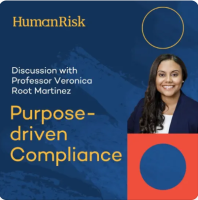
Professor Veronica Root Martinez on Purpose-Driven Compliance
Who determines what 'good' Compliance actually looks like? The obvious answer is regulators (and in some jurisdictions) prosecutors. But what if it were the regulated Firms themselves? That's the idea behind purpose-driven compliance, which I'm exploring on this episode.
Episode Summary
To explore this, I'm joined by Veronica Root Martinez, Professor of Law at Duke University School of Law, to explore a deceptively simple but unsettling idea: 100% compliance is impossible. While we often behave as though perfect compliance is the goal — and in some safety-critical domains it must be — most organisational compliance involves humans. And humans make mistakes. Things get missed. Context changes. Stuff goes wrong.
So if perfection isn’t realistic, the real question becomes: how do organisations decide what really matters? The traditional answer has been to look outward — to regulators, enforcement authorities, and in some jurisdictions (particularly the US), prosecutors. Their priorities, expressed through sentencing guidelines, enforcement actions, and settlements, end up defining what “good” compliance looks like.
Veronica challenges that logic. She argues that this gets things the wrong way round. Instead of letting enforcement priorities dictate behaviour, she makes the case for purpose-driven compliance — where organisations set their own priorities based on their purpose, values, and actual risks, rather than chasing shifting regulatory expectations. Along the way, the conversation explores culture, human judgment, psychological safety, technology, experimentation, and why “best practice” can sometimes make things worse rather than better.
This episode is for anyone who writes rules, enforces them — or simply has to live under them.
Guest Biography
Veronica Root Martinez is a Professor of Law at Duke University School of Law, where she researches corporate compliance, ethics, and organisational culture. Her work on purpose-driven compliance challenges enforcement-led models and explores how organisations can set priorities based on their own purpose, values, and risks.
Before entering academia, Veronica practised as an associate at a large law firm in Washington, DC, where she worked on regulatory and white-collar matters — experience that strongly informs the practical orientation of her research.
Speakers